Insurance is worth buying when a loss would be catastrophic and you could not absorb it. That single test disqualifies most of the insurance products you will be offered in your life.
The reason so many bad products exist is that insurance is enormously profitable to sell at the point of another transaction. The cashier, the finance manager, and the loan officer are all compensated for adding it, and the moment they ask is the moment you are least prepared to evaluate it.
Here is what to decline, and why.
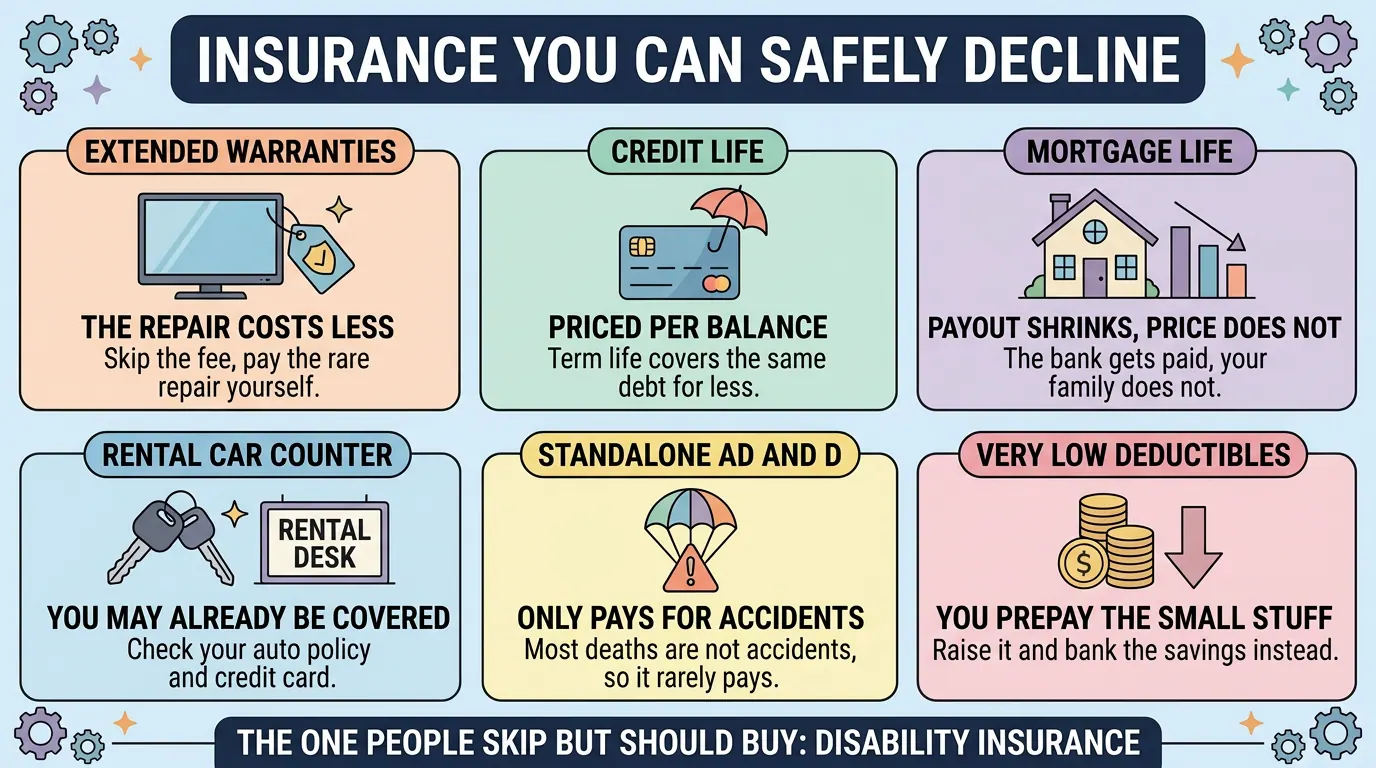
Extended Warranties
Offered on electronics, appliances, and cars, usually at checkout, usually for 10% to 20% of the purchase price.
The problem is that the covered loss is not catastrophic. If a $600 laptop failing would not damage your finances, you should not insure it. You should self-insure, which means absorbing the occasional replacement out of savings and keeping the premiums you did not pay.
Three additional reasons these are poor value. Manufacturer warranties already cover the first year, when defects are most likely. Many credit cards automatically extend the manufacturer warranty on purchases made with the card, so you may be buying coverage you already have. And the exclusions are broad, with accidental damage frequently not covered at all.
Consumer research has consistently found that products rarely fail during the extended warranty window, and that repair costs when they do often land close to the warranty price.
Credit Life and Credit Disability Insurance
Sold alongside loans, most often auto loans and personal loans. It pays off the loan balance if you die or become disabled.
Two structural problems.
The benefit shrinks while the price does not. As you pay down the loan, the amount the policy would pay declines, but your premium generally does not fall with it. You pay a level price for a coverage amount that decreases every month.
The pricing is poor. Term life insurance costs roughly $25 to $30 per month for $500,000 of coverage for a healthy 30-year-old. Credit life insurance frequently costs more per dollar of coverage than that by a wide margin, largely because it is sold without underwriting and without comparison shopping.
If you need coverage for a loan balance, a term policy sized to your total obligations does the same job better and cheaper, and the payout goes to your family rather than directly to the lender.
Mortgage Life Insurance
Same product, larger loan. It pays off your mortgage if you die.
Same two problems: the benefit declines as you amortize the loan, and the payout goes to the lender rather than to your family.
That second point deserves emphasis. With a term life policy, your beneficiaries receive the money and decide what to do with it. They might pay off the mortgage. They might keep the low-rate mortgage and use the money for living expenses, which could be the smarter choice. Mortgage life insurance removes that decision.
Buy term life sized to include your mortgage balance and let your family choose.
Rental Car Insurance at the Counter
The most common duplicate purchase in America, offered under pressure, at a counter, after a flight.
Before you accept it, check three things you may already have.
Your personal auto policy generally extends to rental cars in the United States, including liability and, if you carry them, collision and comprehensive.
Many credit cards provide rental car coverage automatically when you pay with the card, though most are secondary, meaning they cover what your auto insurance does not.
Your renters or homeowners policy covers personal belongings stolen from the rental.
Two situations where buying at the counter is reasonable: you own no car and therefore carry no auto policy, or you are renting internationally, where your domestic auto coverage typically does not apply. Verify both with a phone call before the trip rather than deciding at the counter.
Standalone Accidental Death and Dismemberment
AD&D pays only if you die or lose a limb in an accident. It pays nothing if you die of illness.
Accidents account for a small minority of deaths. A policy that excludes cancer, heart disease, and stroke is not life insurance, it is a narrow bet on cause of death. It is priced to look cheap because it usually does not pay.
If the coverage is free through your employer, keep it. Do not buy it as a substitute for term life.
Identity Theft Insurance
Marketed heavily, and it does not do what buyers assume.
It generally does not reimburse fraudulent charges, because you are already protected there. Federal law caps your liability at $50 for credit card fraud, and card issuers typically make it zero. Debit card protections are weaker but still cap liability if you report promptly.
What these products actually offer is monitoring and recovery assistance, and most of it is free elsewhere. You can freeze your credit at all three bureaus at no cost, which is the single most effective protection available. You can get free weekly credit reports at AnnualCreditReport.com. And IdentityTheft.gov provides a free government recovery plan.
Very Low Deductibles
Not a product, but the same mistake in a different form.
Choosing a $250 deductible over a $1,000 deductible on your car insurance is buying insurance against $750. That is not a catastrophic loss, and you pay for the privilege every month whether you claim or not.
The typical premium difference runs a few hundred dollars a year. Go three years without a claim and you have saved more than the extra deductible would have cost you once. The condition, as always, is that you need the higher deductible available in cash.
The One That Is Actually Underbought
Worth naming the opposite case, because the same reasoning that rejects the products above endorses this one.
Umbrella liability insurance extends your liability coverage above the limits on your auto and home policies, sold in million-dollar increments, typically for roughly $150 to $600 per year for the first million, with a national average nearer $375.
Liability is exactly the risk that passes the catastrophic test. A serious at-fault accident can produce a judgment far beyond a standard auto policy limit, and the injured party can pursue your income and assets for the difference. That is a loss you cannot absorb, insured cheaply because severe judgments are rare.
Once you have meaningful income or assets to protect, umbrella coverage is among the best values in personal insurance, and almost nobody at a checkout counter will ever offer it to you.
Summary
Insurance is worth buying when a loss would be catastrophic and unaffordable, which disqualifies extended warranties, standalone accidental death coverage, and identity theft insurance whose core protections you already have for free. Credit life and mortgage life insurance both charge a level premium for a benefit that shrinks as you pay down the loan, and term life does the same job cheaper while paying your family rather than the lender. Rental car coverage at the counter usually duplicates your existing auto policy and credit card benefits, so verify before you travel rather than deciding under pressure. The product almost nobody is sold and many people should own is umbrella liability coverage, which extends your liability limits by a million dollars for roughly $150 to $600 a year.