Vanguard sells the S&P 500 two ways. One is a mutual fund with the ticker VFIAX. The other is an ETF with the ticker VOO. Same 500 companies, same weights, nearly the same annual fee. Most people assume they are two names for one thing.
They are not. What differs is the wrapper, meaning the legal and mechanical structure that holds the investments and connects them to your account. The stocks inside are identical. The way you buy in, what you can be charged, and when a tax bill shows up are not.
Mutual funds got there first by about seventy years. The first modern US mutual fund launched in 1924; the first US ETF did not arrive until 1993. Several of the differences below are just the older design showing its age.
What a Mutual Fund Is
A mutual fund pools money from many investors and buys a basket of assets with it. So does an ETF. The split happens at the moment you place an order.
With a mutual fund, you transact with the fund company itself. When you buy, the fund creates new shares and takes your cash. When you sell, the fund destroys your shares and pays you out of its own pocket. No other investor is on the far side of the trade.
With an ETF, you buy from whoever is selling on the exchange that second, the same way you would buy a share of Apple. The fund company is not involved in your order at all. That one structural fact drives almost everything else.
Once a Day vs. All Day
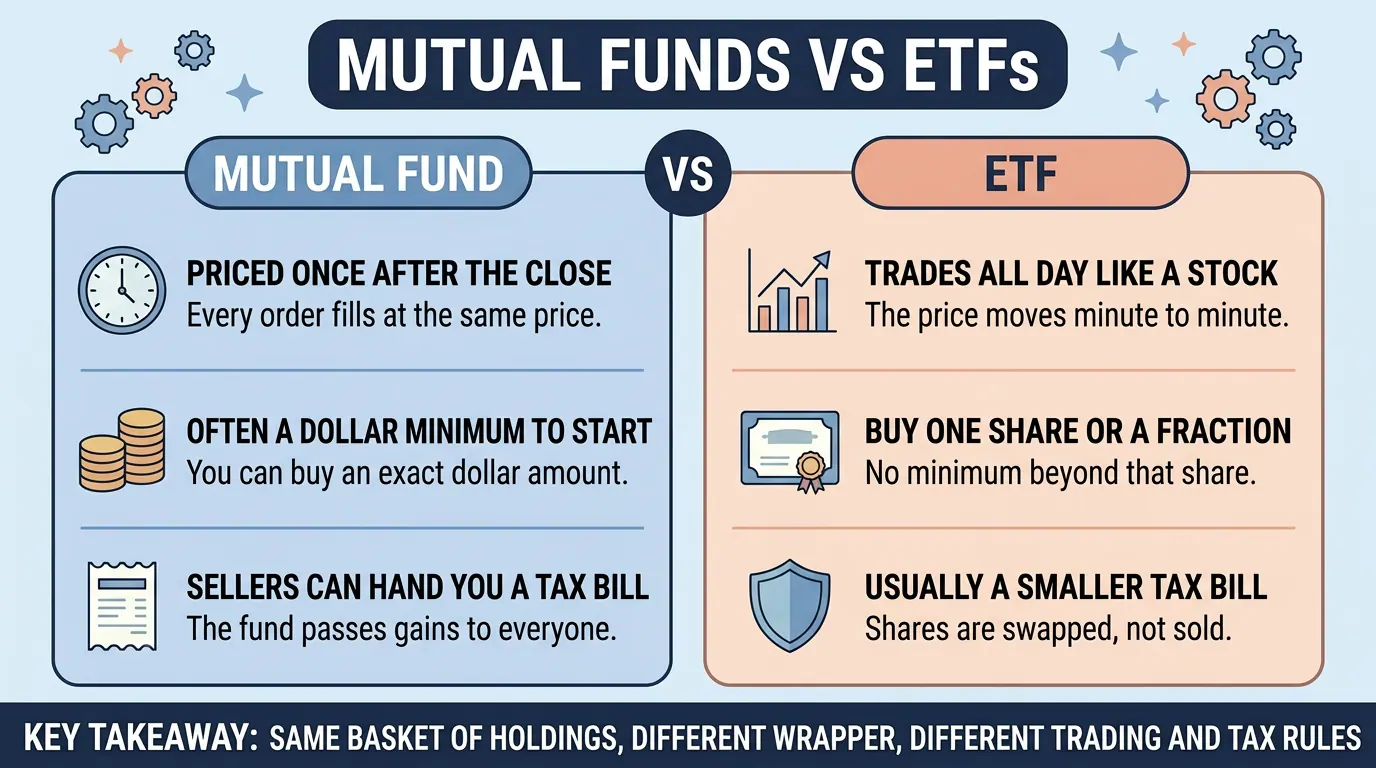
Because a mutual fund has to create or destroy shares at a fair value, it needs one official price. That price is the net asset value, or NAV, which is the total market value of everything the fund owns, minus what it owes, divided by the number of shares outstanding. The fund calculates it once, after the US market closes at 4:00 p.m. Eastern.
So if you place a mutual fund order at 10:30 in the morning, you do not get the 10:30 price. You get that afternoon's closing NAV, whatever it turns out to be. You commit the dollars before you know the price.
An ETF trades continuously while the exchange is open. You can see the price, place a limit order (an instruction to buy only at or below a price you name), and know what you paid. The cost is the bid-ask spread, the gap between the highest price a buyer will pay and the lowest a seller will accept. On a large index ETF that is usually a penny or less per share.
For someone buying once a month and holding for thirty years, this matters far less than it sounds. Intraday pricing is genuinely useful for traders and close to irrelevant for savers.
Minimums and Exact Dollar Amounts
Mutual funds often set a minimum initial investment. A few thousand dollars was standard for years, though plenty of funds have since dropped theirs to $1,000 or to nothing. An ETF has no stated minimum, but you cannot buy less than one share unless your broker supports fractional shares. If a share costs $580, that is the entry ticket.
Past the minimum, the mutual fund becomes the more flexible of the two. Mutual fund shares divide to three decimal places, so $237.14 buys exactly $237.14 worth and nothing is left over. That makes automatic monthly transfers clean and dividend reinvestment complete.
Many brokers now offer fractional ETF shares and recurring ETF purchases, which closes most of this gap. Support is uneven, so check rather than assume.
Loads and 12b-1 Fees
Two charges live in the mutual fund world with no real ETF equivalent.
A load is a sales commission paid to whoever sold you the fund. A front-end load comes out of your deposit before it is invested, commonly around 5.75%, so $10,000 buys $9,425 of fund. A back-end load, sometimes called a contingent deferred sales charge, is taken when you sell and usually shrinks each year you hold.
A 12b-1 fee is an annual charge for marketing and distribution, named after the SEC rule that permits it. It is baked into the expense ratio, so no bill ever arrives. FINRA caps it at 0.75% for distribution plus 0.25% for shareholder servicing, so 1% a year at the maximum.
Neither is unavoidable. No-load index mutual funds with no 12b-1 fee are widely available and are what most index investors own. But loads still exist, still get sold, and are the most expensive thing a beginner can accidentally agree to. Look for the words "sales charge" in a fund's prospectus before buying.
Why ETFs Usually Hand You a Smaller Tax Bill
This is the real difference, and it falls straight out of the create-and-destroy mechanic.
Suppose many investors sell a mutual fund in the same month. The fund has to produce cash, so it sells stock holdings. If those holdings gained value, the sale creates a realized capital gain. A fund does not pay tax on that gain itself; it passes it through as a capital gains distribution, and everyone still holding at year end owes tax on their share.
So you can hold a mutual fund all year, sell nothing, watch it lose value, and still owe tax in December on gains that other people's selling forced the fund to realize.
ETFs mostly sidestep this. Large firms called authorized participants assemble and dismantle ETF shares in big blocks, and they do it in kind, meaning they hand over or receive baskets of the underlying stocks rather than cash. No sale happens, so no gain is realized. The fund can also use those redemptions to send out its lowest-cost shares, quietly flushing unrealized gains out of the portfolio. Broad index ETFs often distribute no capital gains at all, year after year.
One limit on all of this: it only matters in a taxable brokerage account. Inside a 401(k), a traditional IRA, or a Roth IRA, distributions are not taxed when they happen, and the ETF tax advantage disappears.
Where Mutual Funds Still Win
In a 401(k) you usually cannot buy an ETF even if you want to. Plan recordkeeping was built around once-a-day pricing and whole-dollar contributions, and mutual funds fit that. If your plan menu is all mutual funds, pick the cheapest index option and stop worrying about the wrapper.
Mutual funds also take recurring contributions in exact amounts with no fractional-share workaround, carry no bid-ask spread, and always transact at NAV rather than at a market price that can drift from the value of the holdings.
Summary
Mutual funds and ETFs are two containers that can hold the identical index. Mutual funds price once a day at NAV, accept exact dollar amounts, and dominate 401(k) menus, but they can carry loads and 12b-1 fees and can push capital gains distributions onto shareholders who never sold. ETFs trade all day, cost a small bid-ask spread, and use in-kind creation and redemption to avoid most taxable distributions. In a retirement account the wrapper barely matters. In a taxable account the tax mechanics usually favor the ETF.