Put $200 a month into an ordinary brokerage account when a child is born and eighteen years later you have a useful pile of money. You also paid tax on the dividends every year along the way, and you owe capital gains tax when you sell shares to cover tuition. The IRS took a cut of that growth several times before a dollar of it reached the school.
A 529 plan is the workaround Congress built. It is a state-sponsored investment account named after the section of the tax code that created it, and inside it the same $200 a month grows with no annual tax bill and comes out untaxed if you spend it on education.
That is the whole pitch. The rest is rules about what counts as education, and what happens when plans change.
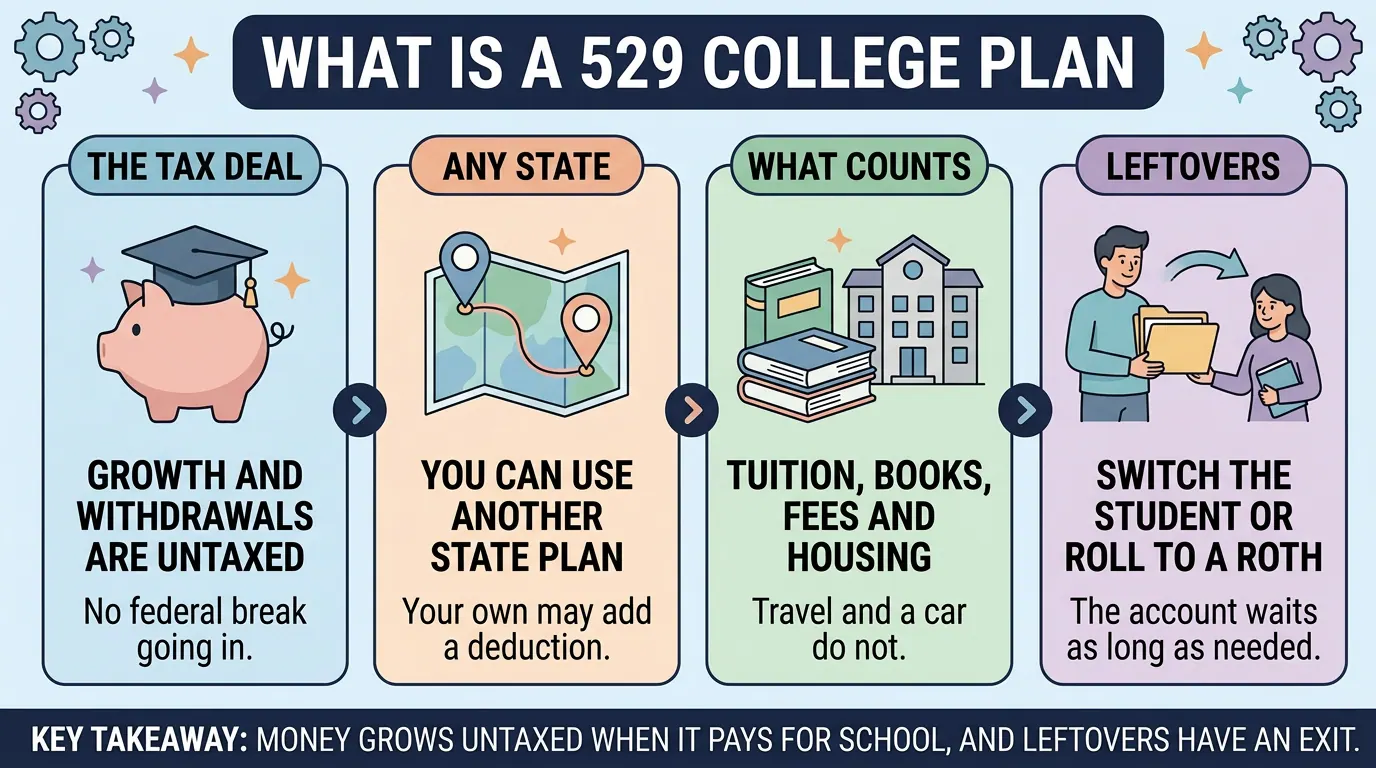
The Tax Deal
Contributions are made with money you have already paid federal income tax on. There is no federal deduction for putting money in. You get two things instead:
Growth inside the account is never taxed year to year. No tax form for dividends, no capital gains bill when the plan rebalances.
Withdrawals are entirely tax free, contributions and earnings alike, as long as the money pays a qualified education expense.
In a taxable account, the same portfolio gives up a slice of its return every year, and that drag compounds for eighteen years. The 529's edge therefore grows the longer the money sits, which is why accounts opened at birth are the ones that matter.
There is no federal contribution limit, but contributions count as gifts, so most families stay under the annual gift tax exclusion ($19,000 per giver per beneficiary in 2026). A special election lets you front-load five years at once, $95,000 from one giver in 2026, if you report it on a gift tax return and make no further gifts to that beneficiary for five years. States separately cap total account value per beneficiary.
You Are Not Limited to Your Own State's Plan
Every state sponsors at least one 529, and you can open almost any state's plan regardless of where you live or where the student enrolls. A Texas family can use New York's plan to pay an Oregon school.
The reason to care about your own state is the state income tax break. More than 30 states offer a deduction or credit for contributions, and most require you to use the in-state plan. Nine states practice what is called tax parity, giving the break for contributions to any state's plan: Arizona, Arkansas, Kansas, Maine, Minnesota, Missouri, Montana, Ohio, and Pennsylvania. Four states with an income tax offer no contribution break at all: California, Hawaii, Kentucky, and North Carolina.
So the order of operations is to check whether your state offers a break, check whether it requires the in-state plan, then weigh that break against the fees and fund menu of the plan you would otherwise pick.
What Counts as Qualified
Tuition and mandatory fees at any eligible institution, meaning one that participates in federal student aid: four-year colleges, community colleges, trade schools, and many schools abroad.
Books, supplies, and required equipment, including a computer used primarily by the student.
Room and board, but only if the student is enrolled at least half time, and only up to the housing and food allowance the school publishes in its cost of attendance. Off-campus rent counts up to that published figure, not up to what you actually pay.
K-12 tuition, plus a wider set of K-12 costs available for distributions made after July 4, 2025, such as tutoring, standardized test fees, and curriculum materials. The annual cap per beneficiary rose from $10,000 to $20,000 starting in January 2026 under the 2025 tax law known as the One Big Beautiful Bill Act.
Fees, books, supplies, and equipment for apprenticeships registered with the US Department of Labor, along with postsecondary credentialing and licensing costs for distributions made after July 4, 2025.
Student loan repayment, capped at $10,000 over the beneficiary's lifetime, with a separate $10,000 available for each of the beneficiary's siblings.
Transportation and health insurance do not qualify. States also did not all adopt the federal expansions, so yours may still treat K-12 costs or loan repayment as non-qualified for state tax purposes even though the IRS does not.
What a Non-Qualified Withdrawal Costs
Every distribution splits proportionally between contributions and earnings. Contributions were already taxed and always come out free. Only the earnings portion is exposed, and on that portion you owe ordinary income tax at the recipient's rate plus a 10% federal penalty. Your state may also reclaim deductions you took in earlier years.
Say an account holds $30,000, of which $10,000 is earnings, so earnings are one third of the balance. Withdraw $6,000 for something that does not qualify and $2,000 of that is earnings. You owe income tax on $2,000 and a penalty of $200, not on the full $6,000.
The 10% penalty is waived, though income tax on earnings still applies, if the beneficiary receives a scholarship (up to the scholarship amount), attends a US service academy, becomes disabled, or dies. Amounts used to claim the American Opportunity or Lifetime Learning credit also escape the penalty, since you cannot take two federal breaks on the same expense.
When the Money Is Not Needed
The fear behind most unopened 529 accounts is a child who wins a scholarship, joins the military, or skips college entirely. You can change the beneficiary instead, with no tax and no penalty, as long as the new one is a family member of the old one. That definition is wide: siblings, parents, children, first cousins, nieces and nephews, in-laws, and eventually the beneficiary's own children. Plenty of parents shift leftover money to a younger sibling, or to themselves for a graduate program.
The Roth IRA Rollover and Its Fine Print
Under a 2022 law called SECURE 2.0, leftover 529 money can be rolled into a Roth IRA belonging to the beneficiary, starting in 2024. The option is genuinely useful and fenced in on every side:
The 529 account must have been open at least 15 years. Changing the beneficiary is widely read as restarting that clock, though the IRS has not issued final guidance settling it.
Contributions made in the last five years, and earnings on them, cannot be rolled.
The cap is $35,000 over the beneficiary's lifetime, counted across every 529 naming that person.
Each year's rollover counts against the beneficiary's own annual Roth IRA contribution limit, $7,500 in 2026, so using the full cap takes at least five separate years.
The beneficiary needs earned income at least equal to the amount rolled that year, and it must move as a direct trustee-to-trustee transfer.
Some states, California among them, tax the rollover even though the federal government does not.
The Financial Aid Effect Is Smaller Than People Think
A 529 owned by a parent, or by a dependent student, is reported on the Free Application for Federal Student Aid (FAFSA) as a parent asset. Parent assets are assessed at a maximum of 5.64%, so $50,000 in a 529 raises what the family is expected to contribute by at most about $2,820 for that year.
Money held in a child's own name outside a 529 is assessed at 20%, which does more damage. And starting with the 2024-25 FAFSA, distributions from a grandparent-owned 529 no longer count as student income, closing a trap that used to cut aid sharply the year after grandparents helped.
Age-Based Investment Tracks
Most plans default you into an age-based portfolio, sometimes called enrollment-date. It holds mostly stock funds while the child is young and shifts automatically toward bonds and cash as enrollment approaches, along a glide path the plan sets.
The logic is time. A seven-year-old's account can absorb a bad market year because it has eleven years to recover. A seventeen-year-old's cannot, since the first tuition bill arrives on schedule regardless of what the market did that spring. Static portfolios you steer yourself are also offered, but federal rules let you change investment selections only twice per calendar year, so a 529 is not an account to trade in.
Summary
A 529 grows free of annual taxes and pays out free of tax when the money covers qualified education costs, which now stretch from K-12 tuition through apprenticeships, credentialing, and $10,000 of student loans. You may use another state's plan, though your own state's deduction or credit can outweigh a cheaper outside option. Money that goes unused can move to another family member, roll into the beneficiary's Roth IRA up to $35,000 under SECURE 2.0, or come out with tax and a 10% penalty charged on the earnings portion alone.