A 1% fee sounds like a rounding error. It is one penny on the dollar. Nobody negotiates over a penny.
The US Department of Labor publishes an example that shows what that penny actually does over a career, and it is the single most useful piece of arithmetic in retirement investing.
Take a worker with $25,000 in their retirement account and 35 years until retirement. Assume a 7% average annual return and no further contributions, so the only variable is fees.
At 0.5% in annual fees, the account grows to about $227,000.
At 1.5% in annual fees, the account grows to about $163,000.
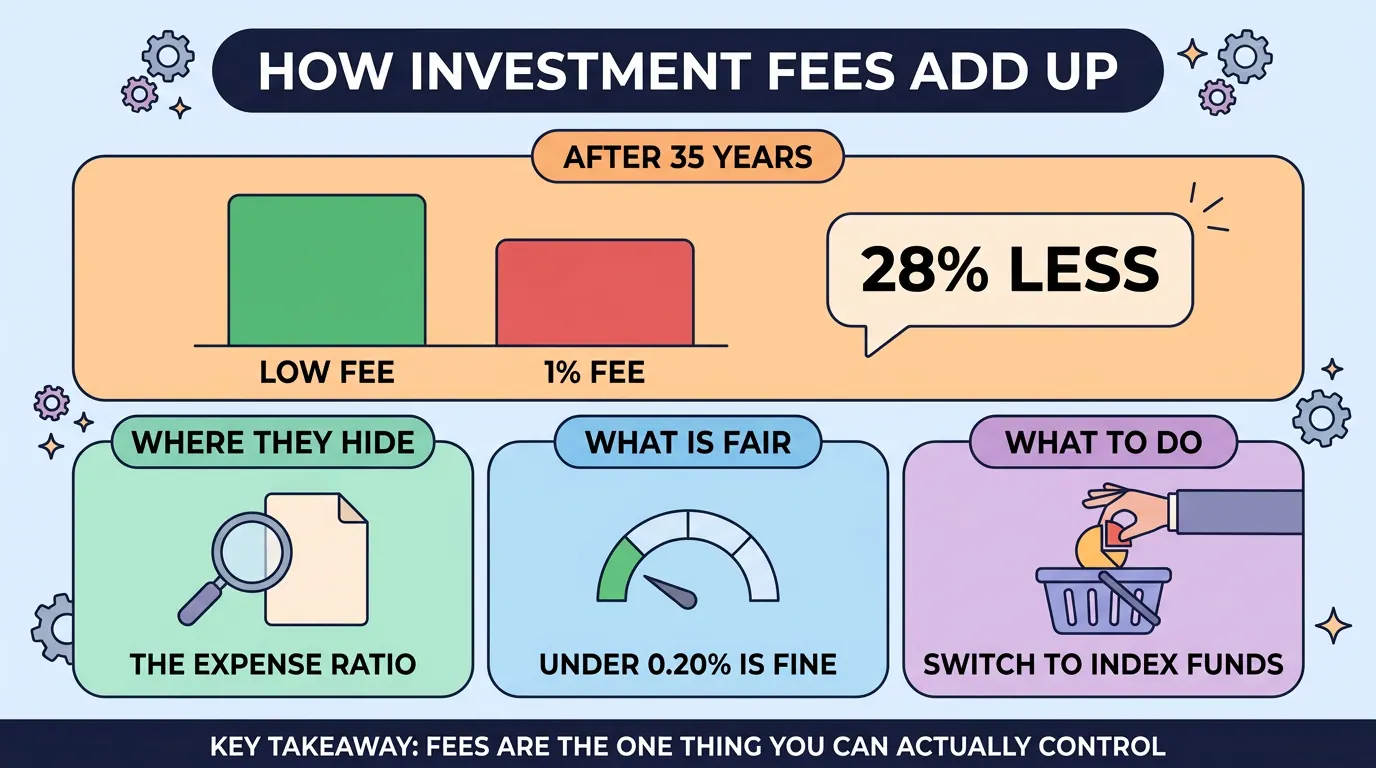
The Labor Department's own summary of that result: a 1% difference in fees and expenses would reduce your account balance at retirement by 28%.
Not 1%. Twenty-eight percent. More than a quarter of the account, gone, from a number most people never look up.
Why a Small Fee Does Enormous Damage
The reason is that fees compound against you exactly the way returns compound for you.
Compounding means your investment gains generate gains of their own. Earn 7% on $10,000 and you have $10,700; the next year you earn 7% on the larger amount, including on last year's gain. Over decades this is where nearly all of your growth comes from.
A fee reverses the process. Every dollar taken out this year is a dollar that cannot compound for the next thirty. The fee is not really 1% of your balance. It is 1% of your balance plus everything that dollar would have become.
This also explains why the damage grows the longer your horizon. A 22-year-old paying high fees loses far more, proportionally, than a 55-year-old paying the same fees. The people with the most to lose are the ones least likely to check.
Where the Fees Actually Are
Retirement fees hide in two places, and you need to look at both.
The fund's expense ratio. Every mutual fund charges an annual percentage of your balance. This is by far the larger cost for most people, and it is entirely within your control because you chose the fund.
Reasonable numbers:
Index funds, which simply hold everything in a market index rather than paying a manager to pick investments: often 0.02% to 0.10%
Target-date funds, which manage your stock-to-bond mix automatically: an industry asset-weighted average of 0.27% in 2025, down from roughly 0.55% a decade earlier
Actively managed funds, where a manager picks holdings: frequently 0.50% to 1.00% or more
The plan's administrative fees. Your employer's 401(k) provider charges for recordkeeping and administration, sometimes as a flat annual dollar amount and sometimes as a percentage of assets. You cannot shop this one. Smaller employers tend to have worse pricing than large ones, because they have less negotiating leverage.
Both are disclosed. Federal rules require your plan to send you an annual fee disclosure, and every fund publishes its expense ratio on a one-page fact sheet. Almost nobody reads either document, which is precisely why the fees persist.
There is a third layer if you hire help. A financial advisor or wealth manager typically charges an assets under management fee of around 1% per year, and that charge sits on top of the expense ratios of the funds they put you in, so the two costs stack.
The Question That Settles Most Decisions
When two funds on your menu track the same index, the cheaper one is strictly better. Not usually better. Strictly better, because you are buying identical holdings and paying different prices for them.
This is worth stating plainly because the fund industry markets heavily against it. Higher fees are frequently presented as buying superior management. Over long periods, most actively managed funds fail to beat the plain index they are measured against, and the fee is a guaranteed cost while the outperformance is a hope.
You are not being asked to predict which manager is skilled. You are being asked whether to pay more for the same thing.
Using Two Accounts to Escape Bad Fees
If your workplace plan has an expensive fund menu, you are not stuck with it, and this is where the account structure becomes useful.
The usual sequence:
Contribute to your 401(k) at least up to your full employer match. An employer match is additional money your employer deposits when you contribute your own, commonly 50 cents per dollar on the first 6% of pay. Even a badly priced plan is worth using to capture free money.
Then fund an IRA, which you open yourself at a brokerage. An IRA gives you access to essentially the entire market, including index funds priced near zero, rather than whatever menu your employer selected.
Then return to the 401(k) if you still have money to save.
The two contribution limits are separate, so you can use both in the same year. For 2026 that is $24,500 in a 401(k) and $7,500 in an IRA.
There is also a moment of real leverage when you change jobs. Rolling an old 401(k) into an IRA moves that entire balance out of an expensive menu permanently. If the old plan charged 0.90% and your IRA fund charges 0.04%, you just captured most of that 28% for yourself.
What to Do This Week
Three steps, and none takes more than fifteen minutes.
Look up the expense ratio of every fund you currently hold. Your plan's website lists them, usually beside the fund name.
Compare each one against the cheapest broadly similar option on the same menu. If you hold a 0.80% actively managed US stock fund and a 0.04% US stock index fund sits three rows below it, that is a free upgrade.
Check whether any old 401(k) accounts from previous jobs are still sitting in expensive plans. Forgotten accounts are common and they keep charging fees the entire time.
Summary
The Department of Labor's example shows that a 1% difference in annual fees reduces a retirement balance by 28% over 35 years, turning $227,000 into $163,000, because fees compound against you the same way returns compound for you. Costs come from the fund's expense ratio, which you choose, and the plan's administrative fees, which you cannot. Index funds commonly charge under 0.10% while actively managed funds often charge 0.50% or more for the same market exposure, so when two funds track the same index the cheaper one is strictly better. If your workplace menu is expensive, capture the employer match first, then use an IRA for its far wider and cheaper fund selection.