Two lines on a tax return, each worth $1,000. One saves you $220. The other saves you $1,000.
That gap is the difference between a deduction and a credit, and it is the most useful thing to understand about the back half of a return. The front half sets your income and filing status, which our tax basics and filing status articles cover. This is what happens after that.
What follows is general information about how the rules work, not tax advice for your situation.
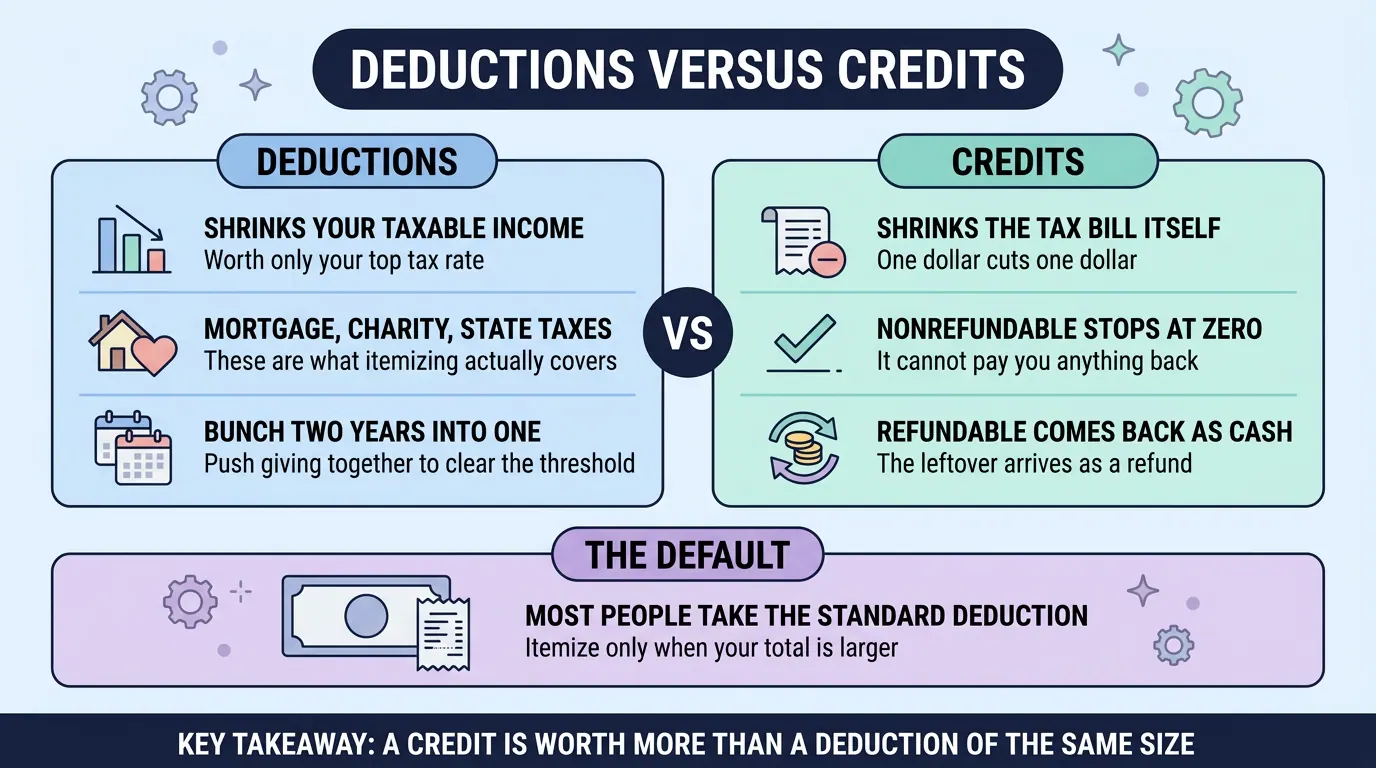
A Deduction Shrinks Income, a Credit Shrinks the Bill
A deduction reduces your taxable income, the figure your tax rate is applied to, so it is worth your marginal rate, meaning the rate charged on your highest dollars of income. A credit reduces the tax you owe, dollar for dollar, after the rates have already run. A $1,000 credit is worth $1,000 to everybody.
Run both through a single filer with $70,000 of taxable income for the 2026 tax year, whose top dollars sit in the 22 percent bracket:
A $1,000 deduction drops taxable income to $69,000. The tax bill falls by 22 percent of $1,000, or $220.
A $1,000 credit leaves taxable income alone and cuts the tax bill by the full $1,000.
A deduction's value therefore depends on who claims it. The same $1,000 write-off saves $120 in the 12 percent bracket and $370 in the 37 percent bracket. Beginning in 2026 there is a ceiling on that, but only at the very top: for filers whose income reaches into the 37 percent bracket, above roughly $640,600 single or $768,700 joint, a new limit trims the tax value of itemized deductions to about 35 cents per dollar instead of 37. Below that income line nothing changes.
The Standard Deduction Is the Default
Every filer picks one of two paths: subtract a single flat amount, or add up specific qualifying expenses and subtract those. The flat amount is the standard deduction. Adding up expenses is called itemizing. You take the larger total, never both.
For the 2026 tax year the standard deduction is $16,100 for single filers and married filing separately, $24,150 for head of household, and $32,200 for married couples filing jointly. These amounts are adjusted for inflation annually. Filers who are 65 or older, or blind, add $2,050 per qualifying condition if single or head of household, and $1,650 per condition if married.
Roughly nine out of ten filers now take the standard deduction. The 2017 tax law nearly doubled the flat amount while capping several itemized categories, and the share of people itemizing fell from about 30 percent to under 10 percent.
What Itemizing Actually Covers
Itemized deductions are a specific list written into law, not any expense that felt necessary. Four categories carry most households:
Mortgage interest, on up to $750,000 of loan principal used to buy or improve your home ($1 million for mortgages taken out before December 16, 2017). Mortgage insurance premiums become deductible again in 2026, phasing out above $100,000 of adjusted gross income, which is your total income minus a short list of specific adjustments.
State and local taxes, meaning state income tax (or sales tax instead) plus property tax, capped at $40,400 for 2026. That is far above the $10,000 cap that applied from 2018 through 2024, and it phases back down above $505,000 of income.
Charitable gifts to qualified organizations. New for 2026, itemizers can deduct only the giving above a floor of 0.5 percent of adjusted gross income.
Medical and dental expenses, but only the part above 7.5 percent of adjusted gross income. On a $60,000 income the first $4,500 of bills does nothing.
A worked comparison. A single filer with $95,000 of adjusted gross income paid $9,000 in mortgage interest, $8,000 in state and property taxes, and gave $2,000 to charity. The charitable floor is $475, so $1,525 of the gift counts. Itemized total: $18,525, against a $16,100 standard deduction. Itemizing wins by $2,425, worth about $534 at 22 percent.
That margin is thin. Paying off the mortgage, or moving to a state with no income tax, flips the answer back.
Bunching: Two Years of Giving in One
If your itemized total lands just under the standard deduction every year, your giving produces no tax benefit at all. Bunching is the fix: give two years' worth in one year and itemize, then give nothing the next year and take the standard deduction.
A single filer with $80,000 of adjusted gross income, $9,000 of other itemized expenses, and $5,000 of annual giving totals $14,000 each year, which loses to the standard deduction both times, for $32,200 deducted over two years. Bunched, year one holds $10,000 of giving less the $400 floor plus $9,000 of expenses, or $18,600 itemized, and year two takes the $16,100 standard deduction. That is $34,700 over the same two years. Same money given away, $2,500 more deducted.
A donor-advised fund is the usual tool: contribute a lump sum, deduct it that year, and pay charities on your own schedule afterward. The new 0.5 percent floor makes bunching more attractive, since you only pay that toll in years you itemize.
Smaller donors have a new option instead. Starting in 2026, people taking the standard deduction can also deduct up to $1,000 of cash gifts ($2,000 if married filing jointly), and unlike several other pieces of that law, this one has no expiration date.
Deductions You Get Without Itemizing
A separate category, called adjustments to income or above-the-line deductions, comes off before the standard-versus-itemized choice is ever made. You get these either way. The main ones, with 2026 figures:
Health savings account contributions, up to $4,400 for self-only coverage or $8,750 for family coverage, if you hold a qualifying high-deductible health plan. Indexed annually.
Traditional IRA contributions, up to $7,500, plus $1,100 more at age 50 and over. Deductibility phases out at higher incomes if you or your spouse are covered by a workplace plan.
Student loan interest, up to $2,500 actually paid, phasing out between $85,000 and $100,000 of modified adjusted gross income for single filers and between $175,000 and $205,000 for joint filers.
Educator expenses, up to $350 of classroom supplies for K-12 teachers and staff who work at least 900 hours in a school year.
Credits, and Whether They Come Back as Cash
A nonrefundable credit reduces your tax to zero and stops. Owe $600, claim a $1,000 nonrefundable credit, and $400 of it evaporates. A refundable credit keeps going past zero, turning the same situation into a $400 refund. A few credits are partially refundable. The major ones, with 2026 figures:
Earned Income Tax Credit. Fully refundable, aimed at people who work and earn modest amounts. The 2026 maximum is $664 with no qualifying children, $4,427 with one, $7,316 with two, and $8,231 with three or more, all indexed annually. The IRS estimates about one in five eligible people never claims it.
Child Tax Credit. $2,200 per qualifying child under 17 for 2026, of which up to $1,700 can come back as a refund. It shrinks once income passes $200,000 ($400,000 for joint filers), thresholds that are not indexed. The child needs a Social Security number.
American Opportunity Tax Credit. Up to $2,500 per student for the first four years of undergraduate study, figured as 100 percent of the first $2,000 of qualified expenses plus 25 percent of the next $2,000. Forty percent of it, up to $1,000, is refundable. It phases out between $80,000 and $90,000 of modified adjusted gross income ($160,000 to $180,000 joint), limits fixed in statute and never indexed.
Lifetime Learning Credit. Up to $2,000 per return, or 20 percent of the first $10,000 of qualified expenses. Nonrefundable, but with no year limit and no requirement that you pursue a degree, so it reaches graduate school and one-off job-skills courses. Same phaseout as above, and you cannot claim both credits for the same student in the same year.
The Saver's Credit is the one most people miss. It returns 50, 20, or 10 percent of the first $2,000 you put into a retirement account ($4,000 for joint filers). It is nonrefundable, and it vanishes above $40,250 of adjusted gross income for single filers, $60,375 for heads of household, and $80,500 for joint filers in 2026. In 2027 it is scheduled to become the Saver's Match, deposited into your retirement account rather than credited on your return.
Summary
A deduction lowers the income your rate applies to, so it is worth your marginal rate, while a credit lowers the bill itself dollar for dollar. Nine in ten filers take the flat standard deduction, though homeowners in high-tax states with real charitable giving should run both totals and consider bunching. Adjustments such as health savings account and IRA contributions work either way, and refundable credits are the only ones that can pay you when you owe nothing at all.