A bond paying 4% in a year when prices rise 5% is a losing trade. You end up with more dollars and less stuff. Ordinary bonds have no defense against this, because the coupon was fixed the day the bond was issued and inflation was not.
The US Treasury sells two things built for exactly this problem. One is a marketable security that trades in the open market, called TIPS. The other is a savings bond you buy straight from the government and cannot trade at all, called a Series I bond. Both track the Consumer Price Index. Almost everything else about them differs.
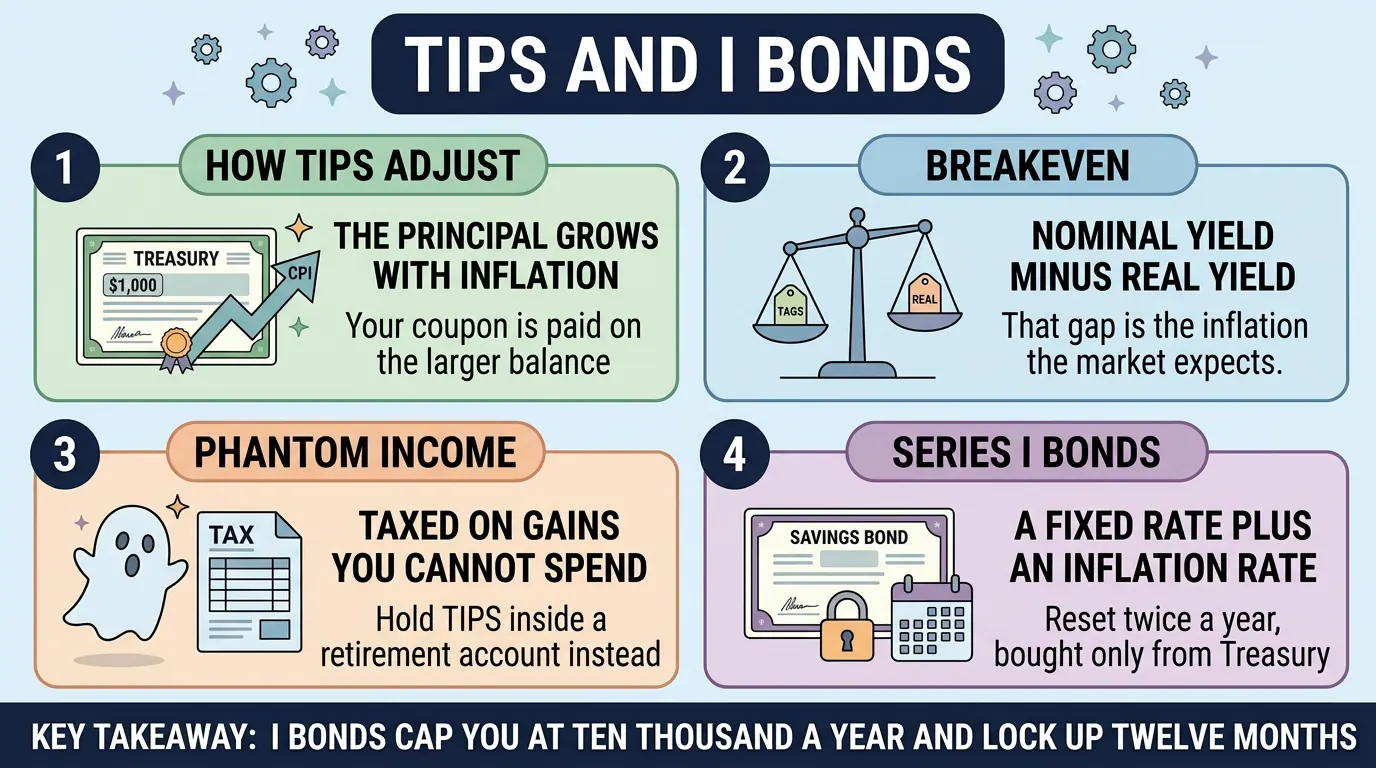
How TIPS Adjust
TIPS stands for Treasury Inflation-Protected Securities. The Treasury issues them in 5-year, 10-year, and 30-year maturities.
Here is the mechanic that confuses people at first: the coupon rate never changes. The principal does. Your principal is adjusted with the Consumer Price Index for All Urban Consumers (CPI-U), the standard measure of US consumer inflation, applied with roughly a three-month lag.
Work an example. You buy $1,000 of TIPS with a 2% coupon. Inflation over the first year runs 3%, so your principal rises to $1,030, and your interest payment is 2% of that, meaning $20.60 rather than $20. Another 3% year takes principal to about $1,060.90 and the payment rises again. The percentage stayed the same the whole time; the base it applies to grew.
At maturity you receive the inflation-adjusted principal or the original face amount, whichever is larger. That is the deflation floor. If consumer prices somehow ended lower than when the bond was issued, you still get your $1,000 back.
One nuance for secondary-market buyers: the floor sits at the bond's original issue amount, not at what you paid. Buy a TIPS that has already accumulated years of inflation adjustments and you paid for that accumulation, which sustained deflation could take back.
Real Yield, Nominal Yield, and Breakeven
A regular Treasury quotes a nominal yield, which is what you earn in plain dollars. Inflation gets subtracted from that later by reality.
TIPS quote a real yield, which is what you earn on top of whatever inflation turns out to be. A real yield of 2.4% means 2.4% above CPI, whatever CPI does. When Treasury auctioned a new 10-year TIPS in July 2026, it came in at a real yield of 2.438%.
Comparing the two gives the breakeven inflation rate: subtract the TIPS real yield from the nominal Treasury yield of the same maturity. If a 10-year Treasury yields 4.5% and a 10-year TIPS yields 2.4% real, the breakeven is about 2.1%. That is the market's rough guess at average inflation over the decade, and the level at which the two bonds deliver the same result.
The decision rule follows. If inflation beats the breakeven, TIPS win; if it comes in lower, the plain Treasury wins. Buying TIPS is not a bet that inflation will be high. It is a bet that inflation will run higher than the market has already priced in.
The Phantom Income Problem
Here is the ugly part of holding TIPS in a taxable account.
The IRS treats each year's principal adjustment as taxable interest income in the year it happens, even though you do not receive that money until maturity. It is called phantom income: a real tax bill on cash you have not been paid.
In a high-inflation year this gets uncomfortable. A large principal adjustment plus a small coupon can leave the tax owed close to or above the cash the bond actually sent you, and the difference comes from somewhere else.
Two things soften it. TIPS interest and inflation adjustments are exempt from state and local income tax, like all Treasury interest. And TIPS funds distribute the adjustment as cash rather than accruing it silently. Even so, the standard handling is to hold TIPS inside an IRA or a 401(k), where annual accruals are not taxed as they occur.
Series I Savings Bonds
I bonds solve the same problem with a completely different design. You buy them from TreasuryDirect, the Treasury's own website. There is no market, no ticker, and no price, so an I bond cannot fall in value.
The rate has two parts. The fixed rate is set when you buy and stays with that bond for its entire 30-year life. The inflation rate resets every May 1 and November 1 based on CPI-U and applies to all I bonds regardless of when they were bought. Combined, they give the composite rate.
For the period beginning May 1, 2026, the fixed rate is 0.90%, the semiannual inflation rate is 1.67%, and the composite rate is 4.26% annualized for six months. Notice which part is durable. Two people holding I bonds bought in different years get the same inflation component and different fixed rates, permanently.
The composite rate can never go below zero. In a deflationary stretch the bond simply earns 0% and your accumulated value holds.
The Limits and the Lockup
I bonds come with restrictions TIPS do not have, and these are why they stay a niche holding rather than a portfolio building block.
You can buy $10,000 of electronic I bonds per Social Security number per calendar year, so $20,000 for a married couple across two accounts. The old option to buy an extra $5,000 in paper I bonds with a tax refund ended on January 1, 2025.
You cannot redeem at all for the first 12 months, with narrow exceptions for federally declared disasters.
Redeem between one and five years and you forfeit the last three months of interest. After five years there is no penalty.
Taxes are friendlier here. I bond interest is exempt from state and local tax, and federal tax is deferred until you redeem or the bond stops earning at 30 years. Nothing appears on your return in the meantime, so I bonds have no phantom income problem and do not need a retirement account to be tax-efficient.
Different Tools for Different Jobs
I bonds behave like a savings account whose rate chases CPI. Capped size, no market risk, a one-year door lock. They suit money you want to keep pace with inflation and might need in a few years, and the annual cap means building a real position takes years of purchases.
TIPS behave like bonds, because they are bonds. No purchase cap, tradable any day, and a price that moves when real yields move. Rising real yields push TIPS prices down just as rising nominal yields push regular bond prices down. Inflation protection is not price protection.
That last point separates individual TIPS from TIPS funds. Hold an individual TIPS to maturity and you lock in the real yield you bought at. A TIPS fund never matures, so it carries interest rate risk indefinitely and offers no date on which you are made whole.
Summary
TIPS keep a fixed coupon rate and adjust principal with CPI, quote a real yield above inflation, and are worth comparing to nominal Treasuries through the breakeven rate. Their annual principal adjustments are taxed before the cash arrives, which is why they usually live in retirement accounts. I bonds pair a permanent fixed rate with an inflation rate that resets each May and November, cannot lose value, are capped at $10,000 per person per year through TreasuryDirect, and are locked for one year with a three-month interest penalty before year five.