Everything else about insurance is preparation for one moment: the day something goes wrong and you have to collect.
Most people go years without filing a claim, then handle their first one badly, because nothing about the process is intuitive and the incentives on the other side of the phone are not identical to yours.
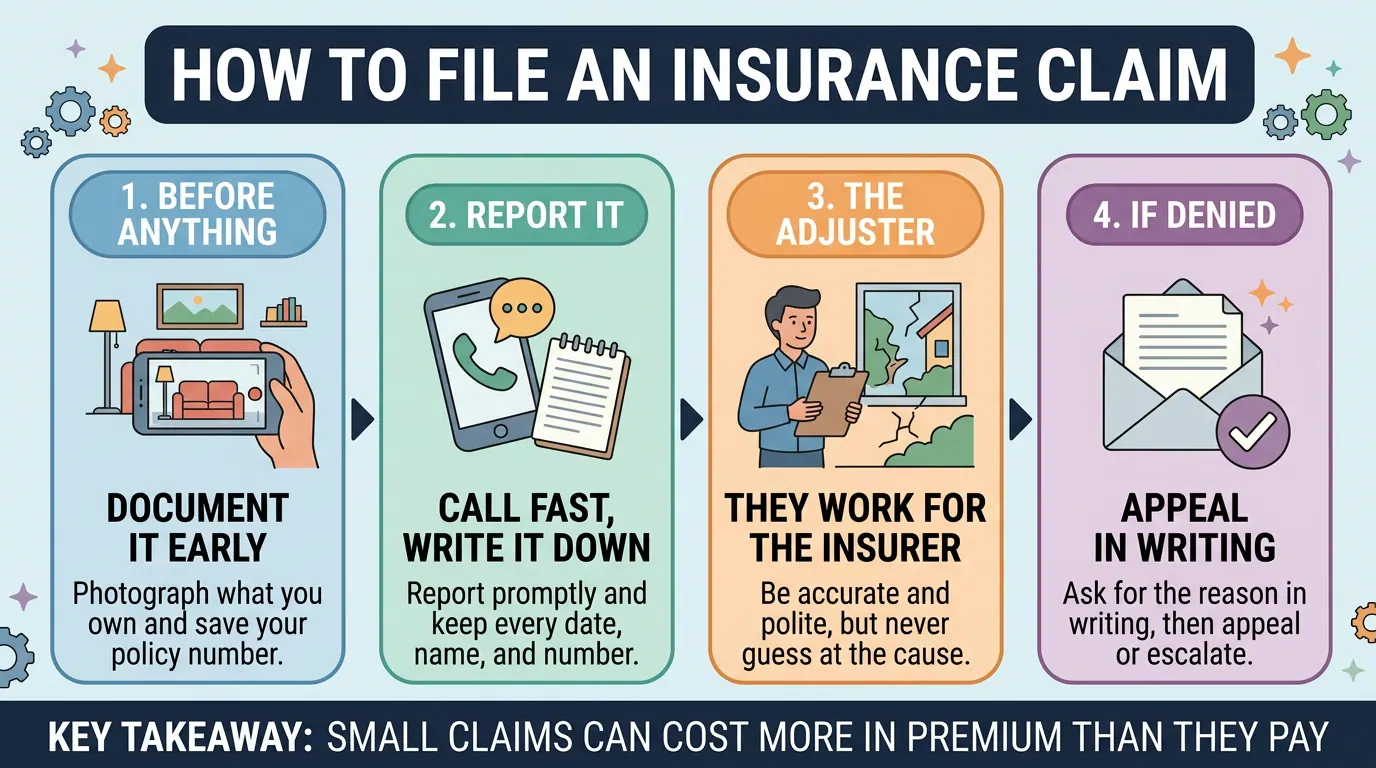
Before Anything Happens
Two things done in advance determine how well a claim goes, and both take under an hour.
Document what you own. Walk through your home with your phone recording video, narrating as you go, and open closets, cabinets, and drawers. Photograph serial numbers on expensive electronics. Store the file somewhere that is not your home, meaning cloud storage or an email to yourself.
The reason this matters: after a fire or burglary, the burden of proving what you owned falls on you. Insurers ask for itemized lists. Reconstructing one from memory, under stress, reliably understates the loss by thousands of dollars.
Know your coverage. Find your declarations page, which is the one-page summary listing your coverage amounts and deductibles. Your deductible is what you pay out of pocket before the insurer pays anything. Knowing whether it is $500 or $2,500 changes whether a given loss is even worth reporting.
The Steps
Handle safety first. Call emergency services if needed, get a police report for theft or an accident, and stop further damage if you can do so safely. Shutting off a water main or tarping a roof is your responsibility. Most policies obligate you to prevent additional damage, and failing to can reduce your payout.
Do not throw anything away. Damaged property is evidence. Photograph everything from multiple angles before moving or discarding it.
Report promptly. Policies require notice within a reasonable time. Same day or next day is safe.
Save receipts for everything. Emergency repairs, a hotel, meals if you are displaced, and the tarp from the hardware store. Loss-of-use coverage reimburses these, but only what you can document.
Keep a log. Every phone call, with the date, the name of the person, and what was said. Claims frequently pass between multiple people, and having your own record resolves contradictions.
What the Adjuster Is
An insurance adjuster investigates your claim, inspects the damage, estimates the cost, and determines what the policy covers.
An adjuster is not your adversary and is also not your advocate. They work for the insurer and their job is to pay what the policy owes, which is not necessarily what you believe it owes. Most are professional and reasonable. The relationship works best when you are organized, factual, and pleasant.
Practical guidance for the inspection:
Be present, and walk them through everything, including damage that is not obvious.
Provide your documentation rather than waiting to be asked.
Answer factually and avoid speculating about cause. "The ceiling was wet when I got home" is a fact. "I think the upstairs neighbor's dishwasher leaked" is a guess that may end up in a file.
Do not accept a settlement figure on the spot if it seems low. You can ask for the itemized estimate and review it.
If your claim is large or complicated, you can hire a public adjuster, who works for you rather than the insurer and typically charges a percentage of the settlement. Worth considering for a major loss, unnecessary for a routine one.
Whether to File at All
Not every covered loss should be reported, and this is the judgment most people get wrong.
Run the arithmetic first. Damage of $1,400 against a $1,000 deductible means the insurer pays $400. That $400 can raise your premiums for the next three to five years by considerably more than $400.
A rough rule: if the claim is not meaningfully larger than your deductible, pay it yourself.
Two additional considerations. Claims stay on your record even when denied or withdrawn, through industry databases that other insurers check. And frequency matters more than size in how insurers view you, so several small claims can hurt more than one large one.
Liability claims are different. If someone was injured on your property or in an accident you caused, report it immediately regardless of apparent size. You are not qualified to predict what a medical claim will eventually total, and failing to report can void coverage entirely.
If You Are Denied
A denial is not final, and insurers do make mistakes.
Get the denial in writing with the specific policy language cited. Read that language yourself, since denials sometimes rest on a misreading of the facts rather than the policy.
Appeal internally first, in writing, addressing the stated reason directly and attaching documentation. Many denials are reversed at this stage.
If that fails, file a complaint with your state department of insurance. Every state has one, complaints are free, and insurers respond to regulators differently than to individuals. This is the most underused consumer tool in insurance.
For health insurance specifically, you also have the right to an external review by an independent third party after exhausting internal appeals.
Choosing an Insurer Before You Need One
All of the above is easier with a company that handles claims well, and price alone will not tell you which those are. Two free checks:
The NAIC Complaint Index. Published by the National Association of Insurance Commissioners, it scores insurers against the average for their size. A score of 1.0 is average, above 1.0 means more complaints than expected, and below means fewer.
AM Best financial strength ratings. Rated from A++ down to D, measuring the insurer's ability to pay claims. Anything in the A range is generally sound.
A policy that is $12 a month cheaper from an insurer with three times the average complaint rate is not a bargain. You are buying the claims experience, and that is the only part of the product that ever gets used.
Summary
Document your belongings on video and store the file off site before anything happens, because proving what you owned is the hardest part of a total-loss claim. When a loss occurs, prevent further damage, photograph everything before discarding it, report promptly, save every receipt, and keep a written log of every call. The adjuster works for the insurer, so arrive organized and factual rather than speculative. Do not file a claim that is only slightly larger than your deductible, since three to five years of higher premiums can exceed the payout, but always report liability claims immediately. If denied, get the reason in writing, appeal internally, and then file a free complaint with your state department of insurance.