Retirement accounts get a tax break in exchange for a promise. The tax break is real. The promise is that the money stays put until you are 59½.
Break it early and the government collects. You pay ordinary income tax on the withdrawal, which you would have owed eventually anyway, plus an additional 10% penalty on top.
Here is what that does to a $20,000 withdrawal for someone in the 22% federal tax bracket, meaning the top slice of their income is taxed at 22%:
Federal income tax: $4,400
Early withdrawal penalty: $2,000
State income tax, in a state that has one: often another $1,000 or more
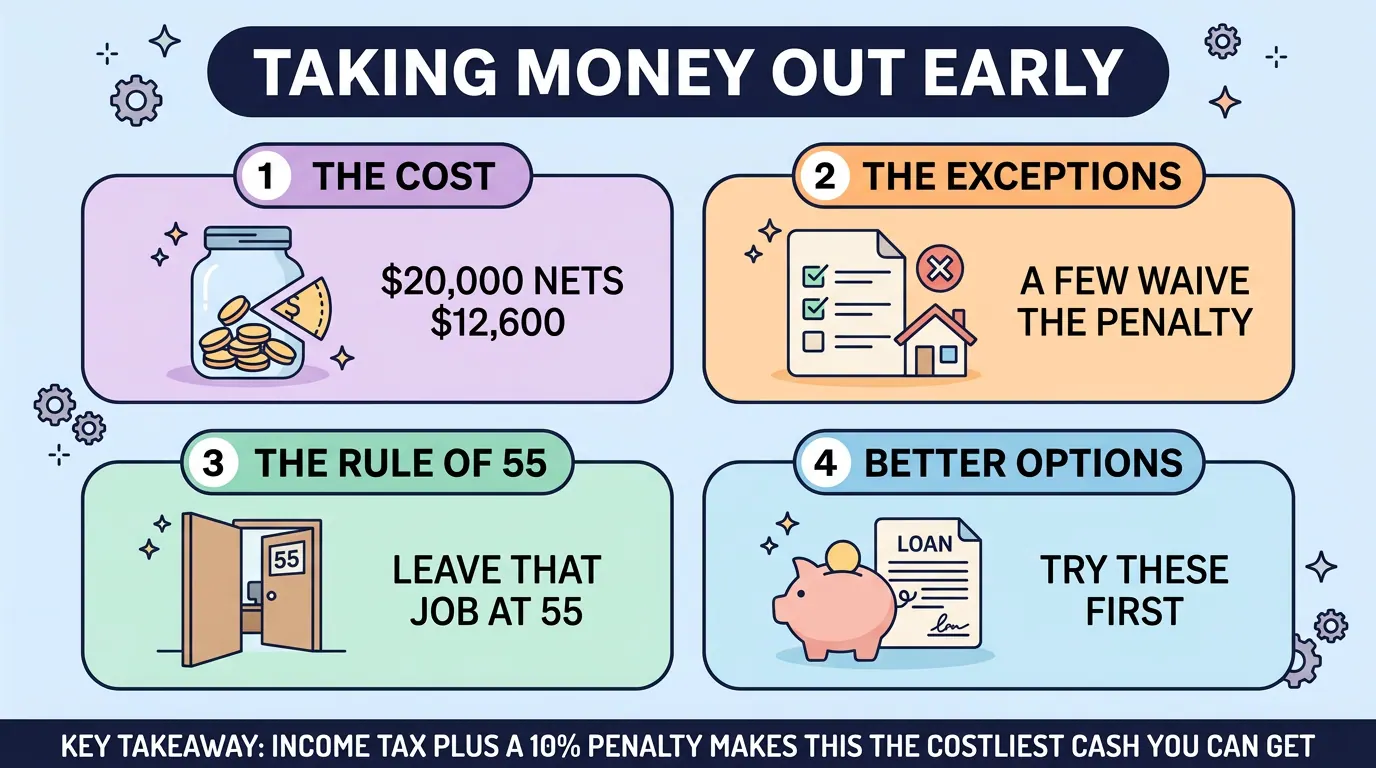
You needed $20,000 and roughly $12,600 reached your bank account. To actually receive $20,000, you would have to withdraw closer to $31,000.
And that understates the cost, because the real loss is the compounding. Compounding means your investment gains generate gains of their own, and it is where nearly all long-term growth comes from. That $20,000, left alone for 30 years at a 7% average return, would have become roughly $152,000. The withdrawal did not cost $7,400 in taxes and penalties. It cost the $152,000 too.
The Exceptions That Actually Exist
The 10% penalty has a long list of exceptions. Note carefully that these waive the penalty only. You still owe income tax on money coming out of a pre-tax account.
Some exceptions apply to both 401(k) plans and IRAs:
Total and permanent disability
Death, for the beneficiary
Unreimbursed medical expenses above a threshold percentage of your income
An IRS levy on the account
Qualified birth or adoption, up to $5,000 per child
Terminal illness
A federally declared disaster, up to $22,000
Domestic abuse victim distributions, limited to the lesser of an indexed cap or half the account
An emergency personal expense distribution of $1,000, available once per year, and you cannot take another one in the following three years unless you repay the first
Some apply only to IRAs, which are the accounts you open yourself rather than through an employer:
Qualified higher education expenses
A first home purchase, up to $10,000 in your lifetime
Health insurance premiums while unemployed
And two special mechanisms deserve their own explanation.
The Rule of 55
If you leave your job during or after the calendar year in which you turn 55, you can withdraw from that employer's 401(k) without the 10% penalty. Public safety employees such as police and firefighters can do this at 50.
Two limits people miss. It applies only to the plan at the job you just left, not to plans from earlier employers and not to IRAs. And rolling that 401(k) into an IRA destroys the option, because the Rule of 55 is a 401(k) provision. Someone planning to retire at 56 should think carefully before consolidating accounts.
Substantially Equal Periodic Payments
Sometimes written as 72(t), after the tax code section. This lets you take penalty-free withdrawals at any age, provided you commit to a fixed schedule of substantially equal annual payments calculated under IRS rules.
The commitment is the catch. You must continue for five years or until you reach 59½, whichever is longer. Someone starting at 45 is locked in for nearly fifteen years. Deviate from the schedule and the penalties get applied retroactively to every payment you already took.
This is a real tool for early retirees and a bad idea for anyone solving a temporary cash problem.
A 401(k) Loan Is Not the Same Thing
Many workplace plans let you borrow from your balance rather than withdraw from it, generally up to 50% of your vested balance or $50,000, whichever is less. You repay yourself with interest over about five years, and there is no tax and no penalty as long as you repay on schedule.
That sounds strictly better than a withdrawal, and in most cases it is, but three things make it worse than it looks.
The borrowed money is out of the market while you repay it, so it stops compounding. You repay with after-tax dollars into an account you will be taxed on again at withdrawal. And if you leave the job, most plans demand the full balance quickly, at which point an unpaid balance converts into a withdrawal with the tax and the 10% penalty attached.
A loan is a better emergency tool than a withdrawal. Neither is as good as an emergency fund.
Roth Accounts Are the Genuine Exception
There is one place where early access is built in rather than penalized.
With a Roth IRA, contributions are made with money you already paid tax on. Because of that, you can withdraw your own contributions at any time, for any reason, with no tax and no penalty. Not the growth. Just the money you put in.
Contribute $18,000 over three years and watch it grow to $24,000, and the first $18,000 remains available to you. The $6,000 of growth stays locked until you qualify, which generally means the account has been open five years and you are at least 59½.
This makes a Roth IRA a reasonable backstop behind a real emergency fund. It should not be your first line of defense, because money withdrawn is permanently removed from decades of tax-free compounding and you cannot put it back beyond the annual limit. But it lowers the stakes of contributing for someone worried about locking money away.
What to Do Instead
The reason people raid retirement accounts is almost never that they wanted to. It is that they had a $4,000 problem and no $4,000.
Three to six months of expenses in a high-yield savings account solves nearly every situation that would otherwise trigger a withdrawal. It earns less than the market. It also never costs you 10% plus income tax plus thirty years of growth.
If you are already in the situation, work down this list before touching a retirement account: the emergency fund, a Roth IRA contribution withdrawal, a 401(k) loan, and only then a hardship withdrawal.
Summary
Withdrawing from a retirement account before 59½ triggers ordinary income tax plus a 10% penalty, so a $20,000 withdrawal can net roughly $12,600 while also forfeiting decades of compounding on the money. A long list of exceptions waives the penalty but not the income tax, including disability, large medical expenses, a $1,000 annual emergency distribution, and up to $22,000 for a federally declared disaster. The Rule of 55 allows penalty-free access to the plan at a job you leave at 55 or later, but rolling that plan into an IRA destroys the option. Roth IRA contributions can always be withdrawn tax and penalty free, which makes a Roth a reasonable backstop behind an actual emergency fund.