If you watch the evening news or scroll through financial headlines, you will inevitably hear politicians and experts arguing about three letters: GDP. They might celebrate that it is growing, or sound the alarm that it is shrinking. It is treated like the ultimate grade for how well a country is doing.
But for the everyday person, a multi-trillion-dollar number can feel entirely disconnected from daily life. What exactly is GDP, how is it measured, and why should you care about it when it comes to your own personal finances and investments?
What Is GDP?
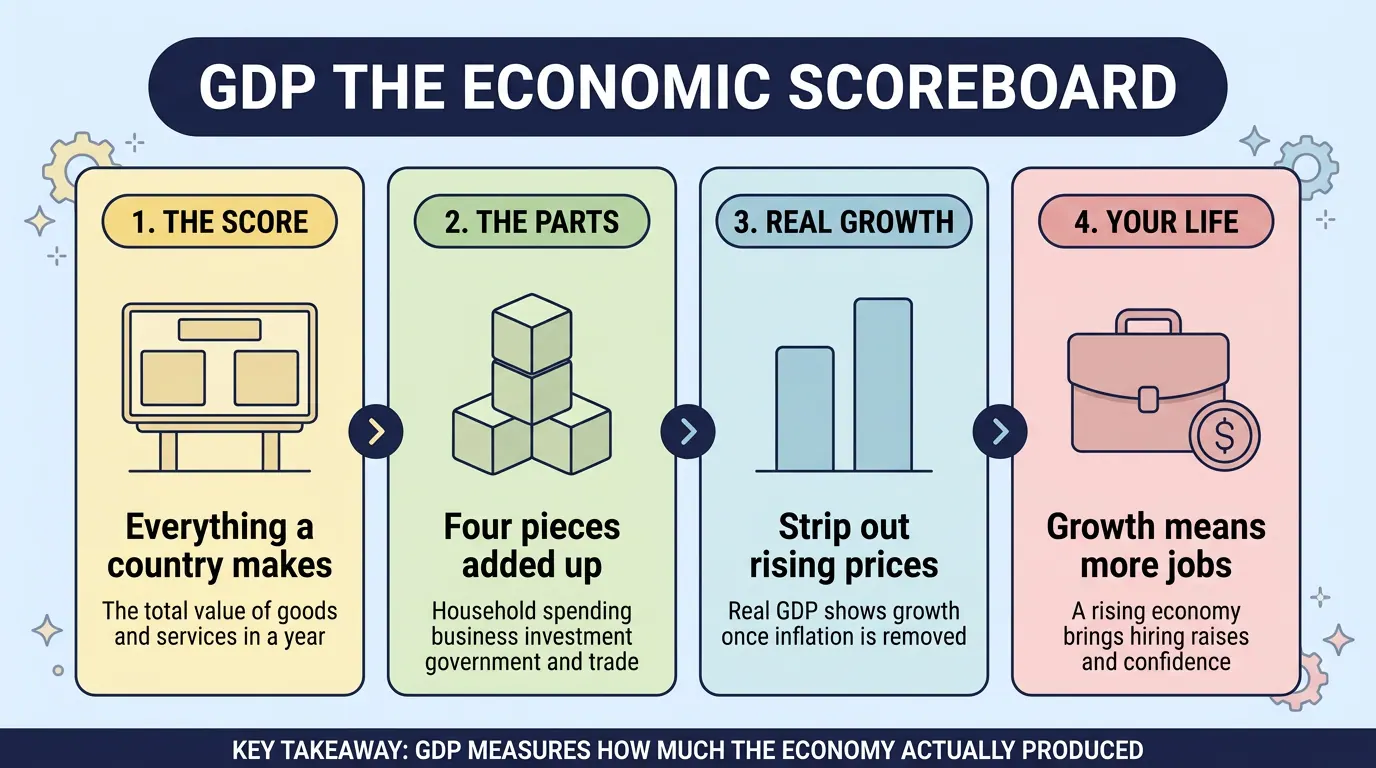
GDP stands for Gross Domestic Product. In the simplest terms, it is the total monetary value of all the finished goods and services produced within a country’s borders during a specific period of time (usually a year or a quarter).
Think of GDP as the ultimate scoreboard for the economy. If you were to add up every cup of coffee sold, every car manufactured, every doctor's appointment billed, and every haircut given in the United States over the course of a year, the grand total is the GDP. It tells us the sheer size and health of the economy. When the number is going up, the economy is growing and creating wealth. When the number goes down, the economy shrinks.
It is worth knowing what the scoreboard quietly leaves off, because GDP counts activity, not wellbeing. Unpaid work does not show up at all, so raising your own children, caring for an aging parent, or cooking dinner at home adds nothing, while paying someone else to do the same tasks does. Environmental damage gets counted strangely too, since a factory polluting a river adds to GDP through its production and the cleanup afterward adds to GDP a second time. GDP also says nothing about who ends up with the money, so a country can post strong growth while most of the gains land with a small slice of the population. That is why GDP per person can climb for years while the typical household still feels like it is falling behind.
How Is GDP Calculated?
To make sense of such a massive number, economists break GDP down into four primary pillars:
Consumer Spending: This is the biggest piece of the pie. It represents all the money everyday people spend on goods (like groceries, clothes, and electronics) and services (like rent, healthcare, and streaming subscriptions). When consumers feel confident and spend money, GDP goes up.
Business Investment: This is the money companies spend to grow. It includes buying new machinery, building new factories, or purchasing software. High business investment means companies are optimistic about the future.
Government Spending: This includes all the money the government spends on things like infrastructure (building roads and bridges), national defense, and public school teachers' salaries.
Net Exports: This is a calculation of what a country sells to the rest of the world (exports) minus what it buys from other countries (imports).
Real vs. Nominal GDP: A Crucial Difference
When reading about GDP, you might see the terms "Real" and "Nominal." This distinction is incredibly important because of inflation.
Imagine a country produces exactly 100 cars one year, and they cost $10,000 each. The GDP is $1,000,000. The next year, the country produces the exact same 100 cars, but because of inflation, they now cost $11,000 each. The new GDP is $1,100,000.
Nominal GDP just looks at the raw numbers, which makes it look like the economy grew by $100,000. Real GDP strips away the illusion of inflation. It accounts for the price changes to show whether the country actually produced more goods and services. Economists and investors rely on Real GDP to get an honest look at true economic growth.
Why GDP Matters to Your Personal Finances
It is easy to assume that a multi-trillion-dollar metric has nothing to do with your personal bank account. However, GDP growth (or shrinkage) creates a ripple effect that directly impacts your everyday life.
Job Security and Wages: When GDP is growing, businesses are making money and expanding. To keep up with demand, they hire more workers and offer higher salaries to attract top talent. Conversely, a common rule of thumb says that if GDP shrinks for two consecutive quarters, the economy is in a recession. The official call comes from the National Bureau of Economic Research, which weighs a broader mix of monthly data on jobs, income, spending and production rather than GDP alone, so its recession dates do not always match that rule. Businesses panic, freeze hiring, and lay off workers.
Interest Rates: If GDP grows too fast, it can cause inflation to spiral out of control. To cool the economy down, the central bank (the Federal Reserve) will raise interest rates. This makes getting a mortgage, auto loan, or carrying credit card debt much more expensive for you.
Stock Market Performance: When you invest in the stock market, you are buying a piece of corporate America. If the GDP is rising, it usually means consumers are spending and companies are logging record profits. This drives stock prices up, growing your retirement and investment accounts. When GDP falls, corporate profits drop, and the stock market often takes a hit.
Summary
GDP is much more than a political talking point or a complex academic metric. It is the pulse of the national economy. By understanding what drives GDP and paying attention to its overall trend, you can gain valuable insight into the safety of your job, the cost of borrowing money, and the future performance of your investments.