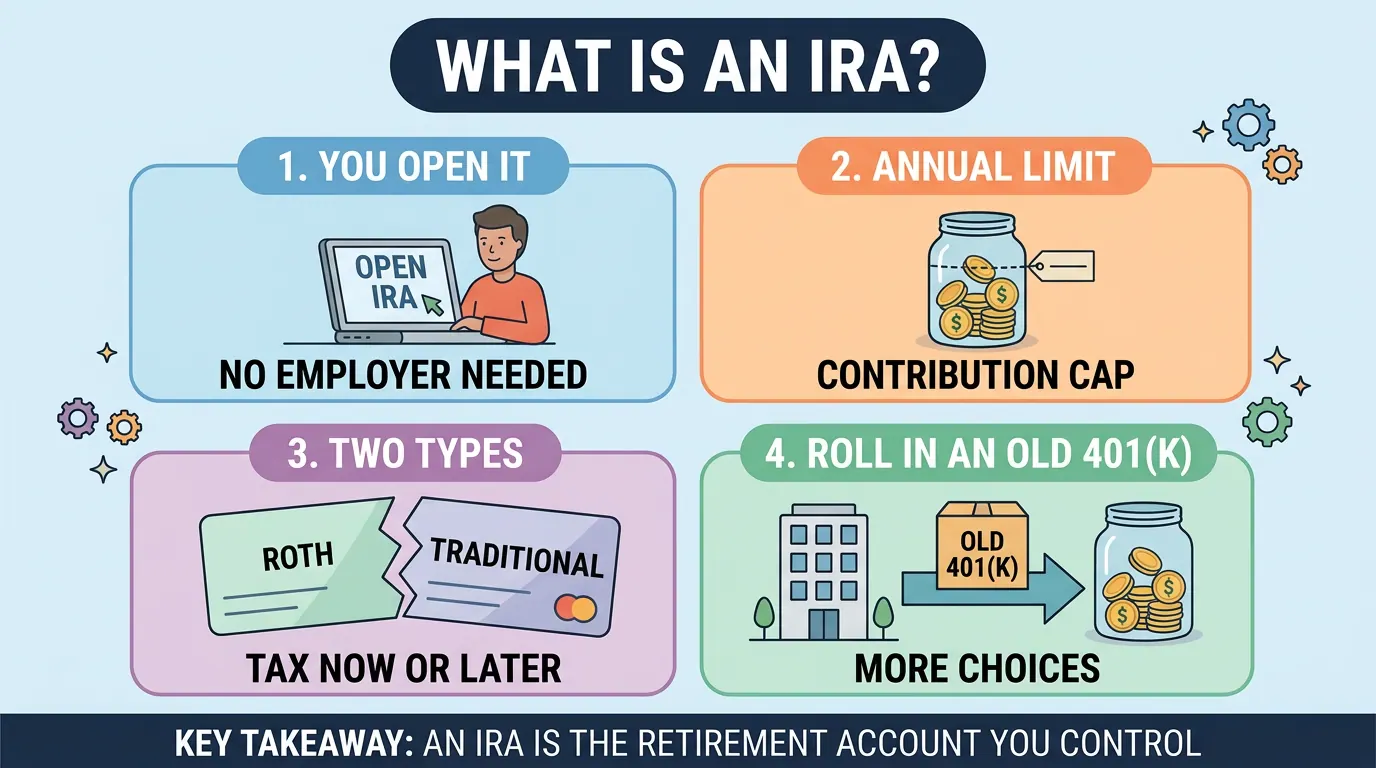
An IRA is a retirement account you open yourself. The letters stand for Individual Retirement Arrangement, though nearly everyone says "account" instead.
The distinction that matters is simple. A 401(k) belongs to your employer's plan. An IRA belongs to you. Your employer is not involved, cannot restrict your investment choices, and has no role in it whatsoever.
That makes an IRA the answer to a common problem: you want to save for retirement, but your job does not offer a plan, or you have already contributed as much as you want to the one it does offer.
Opening One
You open an IRA at a brokerage firm. The process takes about fifteen minutes online and requires your Social Security number, an address, and a bank account to fund it.
There is no employer approval, no HR form, and no waiting period. You can open one in an afternoon.
Once it exists, you connect a bank account and transfer money in. Then, exactly as with a 401(k), you have to choose investments. Funding an IRA is not investing it. Money transferred into an IRA sits in cash until you buy something with it, and forgotten cash in an IRA is one of the more common beginner mistakes.
How Much You Can Contribute
IRA limits are considerably lower than 401(k) limits.
For 2026, you can contribute $7,500 across all your IRAs combined. If you are 50 or older, you can add a catch-up contribution of an extra $1,100.
The word "combined" is important. The limit applies to the total across every IRA you own, not to each one. If you have a traditional IRA and a Roth IRA, you could put $4,000 in one and $3,500 in the other, but you cannot put $7,500 in each.
Two more rules worth knowing:
You need earned income to contribute. Wages, salary, or self-employment income all qualify. Investment income does not. And you cannot contribute more than you earned, so a student who earned $3,000 at a summer job can contribute at most $3,000.
You get until tax day. Contributions for a given tax year can be made until the April filing deadline of the following year. A contribution made in March 2027 can count for 2026 if you designate it that way, which is a useful second chance if you did not get around to it.
The Two Types
IRAs come in traditional and Roth versions, and the difference is the same one that applies to 401(k) accounts: whether you get your tax break now or later.
A traditional IRA may be deductible, which reduces your taxable income for the year. Withdrawals in retirement are taxed as ordinary income.
A Roth IRA gives no deduction. Qualified withdrawals in retirement, including all the growth, are tax free.
The complication specific to IRAs is that both types have income limits, and the limits work differently for each.
Roth IRA eligibility phases out based on income. For 2026, a single filer can contribute the full amount below $153,000, a reduced amount between $153,000 and $168,000, and nothing above $168,000. For a married couple filing jointly, the range is $242,000 to $252,000.
Traditional IRA deductibility phases out only if you are covered by a workplace plan. For 2026, a single filer with a 401(k) at work loses the deduction between $81,000 and $91,000 of income. Without a workplace plan, there is no income limit on deductibility at all.
Note the difference carefully. Income limits stop you from contributing to a Roth IRA. They only stop you from deducting a traditional IRA. You can still make a nondeductible traditional IRA contribution at any income level.
Why Bother If You Have a 401(k)?
Two reasons, and both are practical.
Investment choice. A 401(k) offers whatever menu your employer selected, typically ten to thirty funds, sometimes with high fees. An IRA at a major brokerage gives you access to essentially the entire market, including index funds, which simply hold everything in a market index rather than paying a manager to pick investments, at expense ratios near zero. An expense ratio is the annual percentage a fund charges you; a 0.03% ratio costs $3 per year on a $10,000 balance, while a 1% ratio costs $100. Fees compound against you the same way returns compound for you, so this is not a small difference.
Additional room. The two limits are separate. In 2026 you could contribute $24,500 to a 401(k) and $7,500 to an IRA in the same year, for $32,000 total.
The usual sequencing advice is to contribute to your 401(k) at least up to your full employer match first, then fund an IRA for the better investment options, then return to the 401(k) if you still have money to save. An employer match is additional money your employer deposits into your 401(k) when you contribute your own, commonly 50 cents per dollar on the first 6% of your pay. It is free money available nowhere else, which is why it comes before everything.
Where the Old 401(k) Goes
An IRA is also where most people put money from a former employer's plan. Moving it is called a rollover, and doing it correctly matters.
Ask for a direct rollover, in which the old plan sends the money straight to your IRA. Nothing is withheld and nothing is taxed.
Avoid an indirect rollover, in which the check comes to you. Your old plan is required to withhold 20% for taxes, and you then have 60 days to deposit the full original amount into an IRA, including replacing the withheld 20% out of your own pocket. Miss the deadline or fall short, and the shortfall counts as a taxable withdrawal with a 10% penalty attached.
The two options sound similar and are not. Use the phrase "direct rollover" when you call.
Summary
An IRA is a retirement account you open yourself at a brokerage, independent of any employer, and it comes in traditional and Roth versions with the same now-or-later tax tradeoff. For 2026 the limit is $7,500 across all your IRAs combined, plus $1,100 more if you are 50 or older, and you must have earned income at least equal to your contribution. Income limits restrict who can contribute to a Roth IRA and, separately, who can deduct a traditional IRA. IRAs are worth using alongside a 401(k) for the far wider investment selection and the extra contribution room, and always request a direct rollover when moving money from an old workplace plan.