Your money probably sits in three or four places right now: a checking account, a savings app on your phone, maybe some uninvested cash in a brokerage. Each place is covered by a different system, and one of them may not be covered at all. Here is what each promise actually covers, and how to check yours.
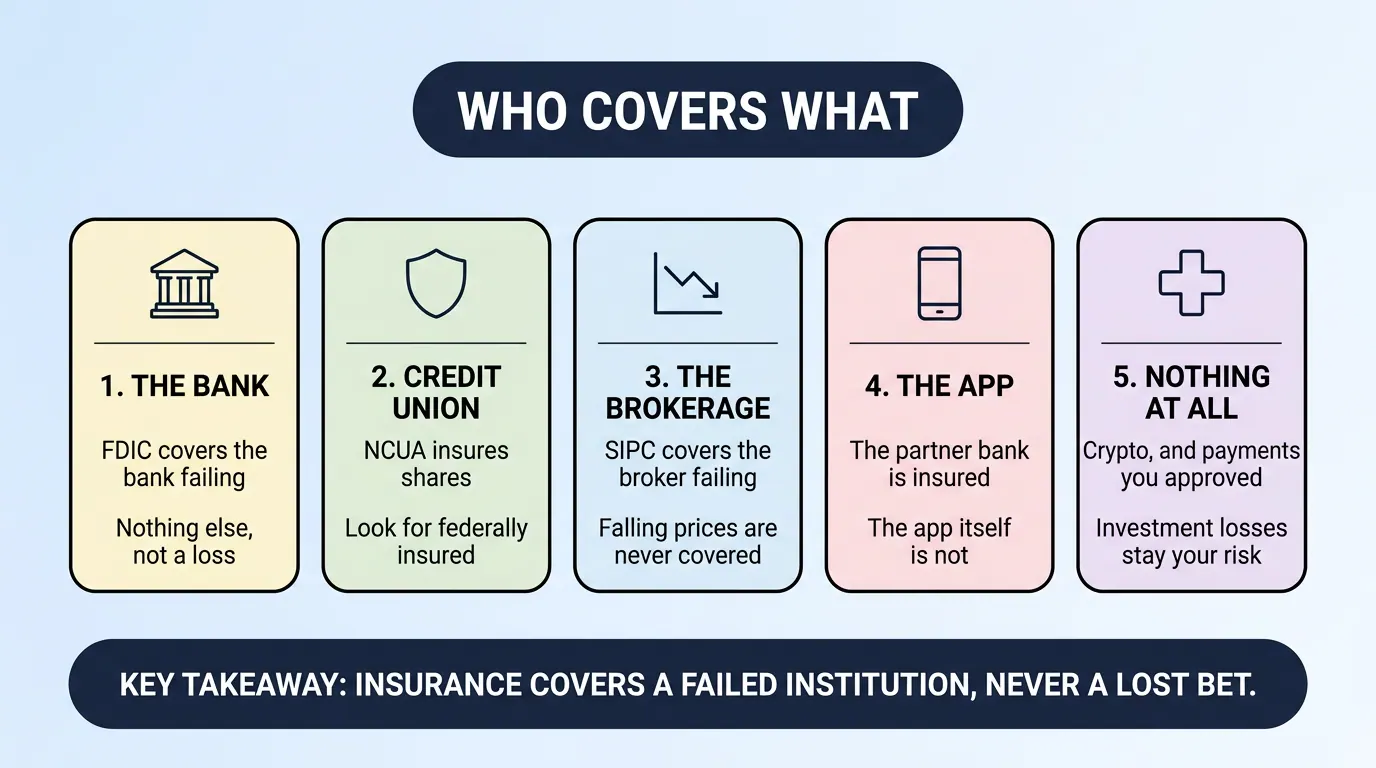
Insurance Against One Thing, and One Thing Only
Deposit insurance protects you against your bank going out of business. That is the whole promise.
If an insured bank fails, a federal agency makes depositors whole up to a limit, and it moves fast. The FDIC says it has historically paid insured deposits within a few days of a closing, usually the next business day, either by moving your account to a healthy bank or by mailing a check. Since the agency opened in 1933, no depositor has lost a penny of insured funds.
It covers nothing else. Not a stock that dropped. Not a wire you sent to someone posing as your landlord. If you were tricked into moving the money yourself, deposit insurance reads that as a transaction, not a failure.
The Phrase That Decides Your Limit
Coverage is $250,000 per depositor, per insured bank, per ownership category. That is the amount Congress set by law in 2010, and only Congress can raise or lower it. The structure matters more than the number.
Break the phrase into three parts. "Per depositor" means you, the person. "Per insured bank" means the limit resets at every separate bank you use. "Per ownership category" is the part almost everyone misses, and it is where the money is.
An ownership category is a legal form of holding an account. Single accounts, joint accounts, certain retirement accounts like IRAs, trust accounts and business accounts are each their own category, and each one gets its own $250,000 at each bank.
Here is what that buys a married couple at a single bank:
Sara's individual checking and savings, added together: insured to $250,000
Dev's individual accounts: insured to $250,000
Their joint account: each co-owner's share is insured to $250,000, so $500,000 total
That is $1,000,000 at one bank. Notice that inside a category, the type of account does not matter. Sara's checking, savings and CD all pour into the same $250,000 bucket.
Credit Unions Are Insured by a Different Agency
People often assume a credit union is the uninsured option. It is not. Federally insured credit unions are covered by the National Credit Union Share Insurance Fund, run by the NCUA. Same limit, same structure: $250,000 per share owner, per insured credit union, per ownership category.
It is a separate agency with a separate fund, so your bank coverage and your credit union coverage never touch. Credit unions also call deposits "shares", which is why the paperwork says share insurance.
One thing to check. A small number of credit unions are privately insured by a company instead of federally insured by the NCUA. Private insurance is a promise from a business, not from the government. Look for the words "federally insured by NCUA".
SIPC Covers a Failed Broker, Not a Failed Investment
This is the distinction people get wrong most often.
SIPC, the Securities Investor Protection Corporation, steps in when a member brokerage fails and customer assets go missing. It works to return your securities and your cash, up to $500,000 per customer, with a smaller sub-limit of $250,000 for cash. Those are the current limits.
What SIPC never does is protect value. In its own words, it "does not protect against the decline in value of your securities." Your shares fall 40%? That is investing, and no insurance covers it. Your broker collapses and your shares cannot be found? That is SIPC's job.
The cash sub-limit is the part that touches most people. Uninvested cash sitting in a brokerage account is protected to $250,000 as cash, not $500,000. Many brokers sweep idle cash out to partner banks, which turns it into an insured bank deposit instead. Whether yours does is worth ten seconds in your settings, because it changes which system stands behind that money.
One lookalike to watch. A money market fund is a security, not a deposit. It sits under SIPC rather than the FDIC, and it can lose value.
When the App Is Not the Bank
Most finance apps are not banks. They are software companies that hold your money at a partner bank, and the coverage reaches you through pass-through insurance.
Pass-through only works when conditions are met. The money has to actually be at an insured bank. The account has to be titled to show it is held for other people. And the records have to say whose money is whose, down to the dollar.
That last condition is where it broke. Synapse was a middleman connecting consumer apps to partner banks. It went bankrupt in 2024, and more than 100,000 people using apps built on it lost access to their money. Later reviews found a gap of tens of millions of dollars between what the partner banks held and what Synapse's ledgers claimed. Some customers were offered a few dollars back out of thousands.
Deposit insurance did nothing, and it was never meant to. No bank failed. The middleman failed. Even where money did sit at a real insured bank, the records could not show who owned which balance, so there was no clean claim to pay. Regulators have since proposed tighter recordkeeping rules for this exact arrangement.
So "FDIC insured" on an app's homepage means the partner bank is insured. It does not mean the app is.
Sweep Programs Multiply Coverage, With One Trap
A sweep program spreads your cash across a network of partner banks, each holding a slice under the limit. Twenty partner banks means twenty separate $250,000 buckets. That is how a cash account advertises millions in coverage without any one bank going over.
The trap is overlap. Say you already hold $200,000 at one of the program banks, and the sweep sends another $100,000 there. You now have $300,000 at that bank in one category, and $50,000 of it is uninsured. The program cannot see your outside accounts.
Any real program publishes its bank list and lets you exclude banks. Read the list, exclude the ones you already use, and check whether your cash is swept right away or parked at the broker first.
What Nothing Insures
Investments that lose value. Stocks, bonds, funds, all of it. Losing money is the risk you were paid to take.
Crypto. Not the FDIC, not the NCUA, and SIPC excludes most digital assets.
Balances kept in a payment app for spending, unless the app really does sweep them to an insured bank. The CFPB has warned that money parked in these apps is often uninsured.
Money you sent to a scammer yourself. You authorized it, so no deposit insurance applies. Tell your bank the same day anyway, because a recall sometimes works.
Safe deposit box contents, plus life insurance policies and annuities sold at a bank.
Check Your Own Coverage in Ten Minutes
Start with where the money is. For each bank, look it up in the FDIC's BankFind tool to confirm it is insured, then run your balances through the FDIC's EDIE estimator, which asks for your account types and reports your covered and uncovered amounts. Credit unions have the same pair of tools on the NCUA's site.
For a brokerage, confirm it appears in SIPC's member list, then find out where uninvested cash goes. For any app that is not a bank, hunt through the disclosures for a partner bank's name. If there is no name to find, treat the money as uninsured and treat the app as somewhere cash passes through, not somewhere it sits.