Scams get rebranded every few months. One season it is a text from a wrong number, the next a fake job posting or a cloned voice on the phone. The machinery under them barely changes, and once you can name its five parts, you can spot a version nobody has warned you about yet.
Why Being Smart Is Not the Defense
A scam is not a puzzle you failed to solve. It is a script built to put you in a state where you stop checking, and people in that state behave alike no matter how sharp they are.
The state is the target. Fear works, excitement works, and so does a problem that has to be fixed before dinner. Once your attention narrows, the habit of confirming a fact stops firing. Your reasoning never fails. It just never gets asked.
So "I would never fall for that" is a risk factor rather than a defense. You will meet yours from the inside, at seven in the evening, while a stranger reads your own address back to you. In Federal Trade Commission complaint data, people in their twenties who report a fraud are likelier to have lost money than people in their seventies. Older victims lose more when it happens: a median around $1,000 in the seventies and $1,650 past eighty, against about $417 in the twenties. No age group is exempt.
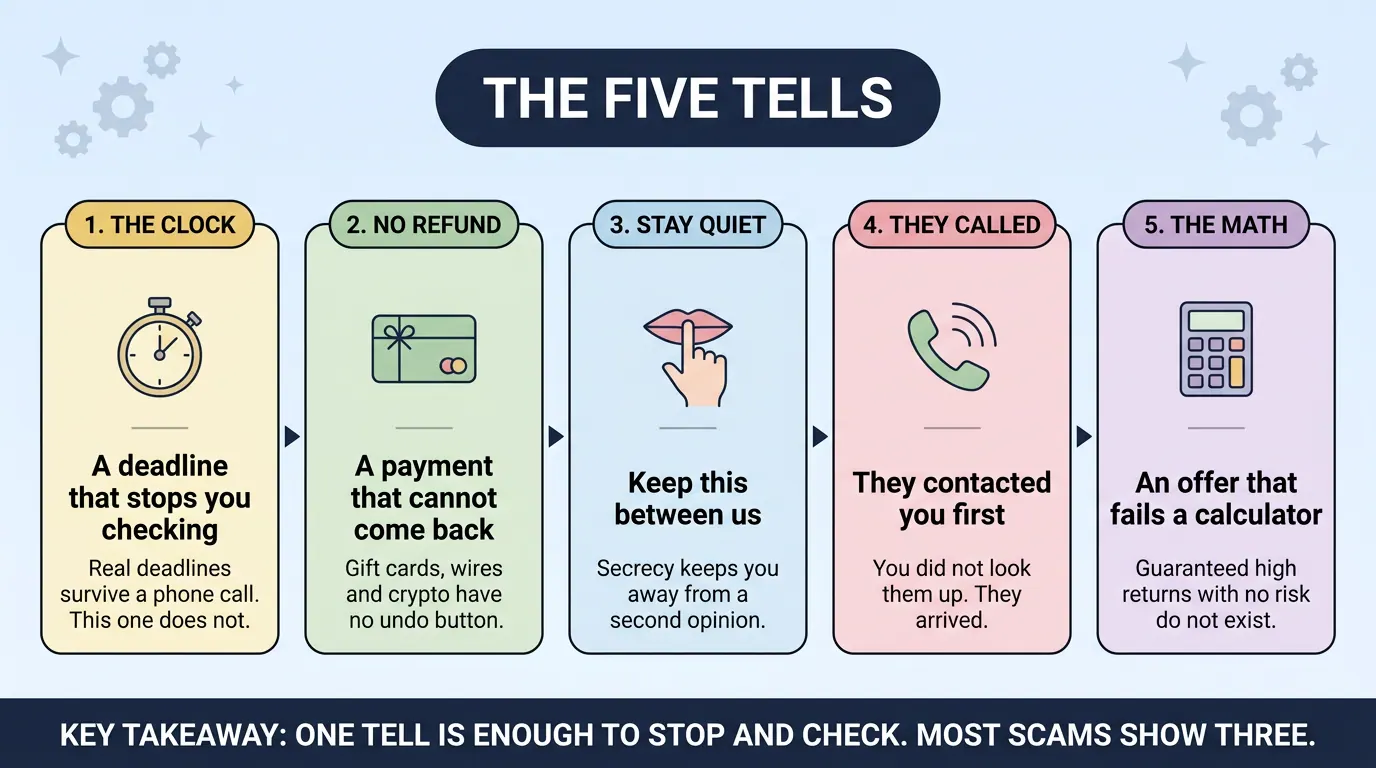
Tell One: A Deadline That Exists to Stop You Checking
Every scam contains a fact that dies on contact with one phone call. There is no warrant. Your account is fine. The script therefore has to expire before you can make that call.
That is the whole job of the deadline. Your account closes at five. The agent leaves in ten minutes. The window never covers a trip to the bank or a call to your sister.
Real deadlines behave differently. A tax bill has a date printed on a letter, and the date is still there tomorrow. A deadline that lives only inside the conversation is the tell.
Tell Two: A Payment That Cannot Come Back
Getting the money back is the biggest risk a scammer runs. Everything before the payment costs them nothing.
So the script steers you to methods with no undo button: gift card codes read aloud, wire transfers, crypto, instant transfers between bank accounts. Speed is the point. The money moves in minutes, and getting it back then depends on someone else, a bank or a card issuer or an exchange, agreeing to freeze it. Call the same day and that sometimes works. The article on payments you cannot take back ranks them.
The tell is the insistence, not the method. No court, tax agency, utility or police department takes gift cards. Someone who cares intensely which rail you use is telling you the rail is the point.
Tell Three: Keep This Between Us
Other people are your immune system. A scam survives only inside one head, so the script keeps it there.
Listen for the reason attached to the secrecy. Do not mention it to the teller, because we think a bank employee is involved. Do not tell your family, they will talk you out of the opportunity. The reason is always for your benefit, and the effect is always the same. Nobody calm hears the story.
The loudest version is being coached on what to say. If a stranger is telling you how to answer your own bank, you have your answer.
Tell Four: They Contacted You First
A scammer has to own the channel. Look up the bank's number yourself and you reach the real bank, which ends it. So contact runs one direction, and every proof on offer loops back through something they gave you: the number in the text, the link in the email, a badge number.
Caller ID proves nothing, since faking it is easy enough that there is a federal law against doing it to defraud people. A familiar voice proves little now that cloning tools need only a short recording. An email address can be one character off.
An authority you did not choose is not an authority. The impersonation playbook has its own article.
Tell Five: An Offer That Fails a Calculator
A con takes weeks of somebody's time, so the payoff has to be worth it. That means promising a return the real world does not produce.
Run the numbers yourself. Three percent a week sounds modest. It turns $1,000 into roughly $4,650 in a year and over $2 million in five. Anyone holding a machine like that has no reason to want your $1,000. The articles on Ponzi schemes and on pump and dump cover where the money really comes from.
Threats fail arithmetic too. Federal cases are not settled by phone for $2,000 in gift cards. A prize that costs money to collect is not a prize.
Stop the Clock, Then Tell One Other Person
One habit disarms all five. Stop, and check through a channel you picked yourself.
In practice: hang up. Find the number yourself, on the back of your card or on the agency's own site typed in by hand. An hour of delay ruins nothing honest. It would ruin this, and that is your answer.
Then tell one person. Someone called me about my account and I am about to send $3,000. The tells are obvious from outside a conversation and nearly invisible from inside one.
If it already happened, one call comes before the rest. Call whoever moved the money: your bank, the wire department, the gift card company, the crypto exchange. Ask them to freeze or recall it, and do it today. Hours matter there and nowhere else. Then report it at ReportFraud.ftc.gov, at ic3.gov if it came over the internet, and to your state attorney general. AARP's Fraud Watch Network runs a free helpline at 877-908-3360, staffed weekdays 8am to 8pm ET. Shame is why people skip this, and silence is the last thing the scam takes from you. The article on identity theft covers what to do when data was taken instead of money. The FTC's fraud tally, republished every March, put 2025 losses at about $15.9 billion, and that counts only the people who reported.