Most people sign their first student loan at seventeen or eighteen, on a financial aid portal that looks like a tax form. The money never touches their hands. It goes to the school, the tuition bill gets marked paid, and the whole thing feels more like paperwork than like borrowing.
The bill arrives four years later, and the balance is usually bigger than the amount borrowed.
Student debt is really two products. One is a federal program whose rules Congress rewrites every few years, and large parts of that rulebook changed on July 1, 2026 under the budget law known as the One Big Beautiful Bill Act. The other is an ordinary private lending market.
Why Federal Loans Come First
Federal student loans come from the US Department of Education. Congress fixes the interest rate once a year, and every borrower taking that loan type pays the same rate regardless of credit. Most undergraduate federal loans need no credit check and no cosigner. You apply by filing the FAFSA, the Free Application for Federal Student Aid.
Private student loans come from banks, credit unions, and online lenders, and the rate is priced off credit history. For a teenager that usually means a parent cosigns and owes the money if the student does not pay.
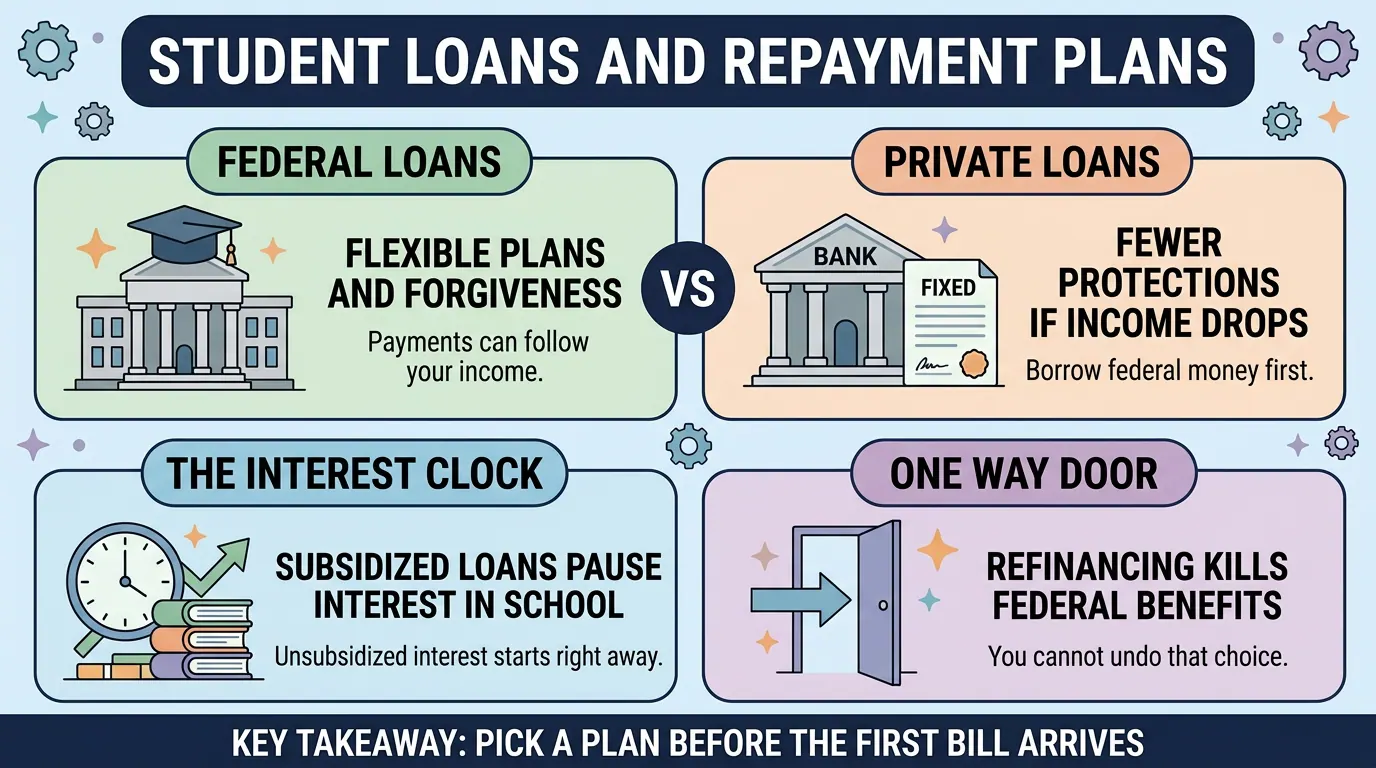
The important difference is not the rate but the rulebook attached. Federal loans carry income-based payment options, legal rights to pause payments, discharge if the borrower dies or becomes permanently disabled, and eligibility for public service forgiveness. Private loans carry whatever the lender chose to offer. Exhaust the federal money first.
Subsidized, Unsubsidized, and the Interest Clock
Two undergraduate loan types matter. Direct Subsidized loans go to students with demonstrated financial need, and the government pays the interest while you are enrolled at least half time, through the six month grace period after you leave, and during approved deferments. Borrow $3,500 as a freshman and you owe $3,500 at graduation.
Direct Unsubsidized loans ignore need and are open to graduate students too. Interest accrues from the day the money is disbursed. A $7,500 unsubsidized loan at a 6.5% rate accrues about $488 a year, so after four years of school and a grace period it enters repayment owing roughly $9,700.
Borrowing is capped. A dependent undergraduate can take $5,500 as a freshman, $6,500 as a sophomore, and $7,500 in each later year, of which only $3,500, $4,500, and $5,500 can be subsidized. The lifetime undergraduate ceiling is $31,000 for dependent students and $57,500 for independent ones.
One more subtraction. An origination fee comes off the top at disbursement, currently 1.057% on subsidized and unsubsidized loans and 4.228% on PLUS loans. Sign for $7,500 and the school receives about $7,421, but you owe the full $7,500 with interest.
Parent PLUS and the New Ceilings
A Parent PLUS loan is borrowed by the parent, not the student, so the parent is legally responsible. The rate runs higher than undergraduate loans and the 4.228% fee applies. Families could once borrow the full cost of attendance minus other aid. Beginning with the 2026-27 school year, Parent PLUS is capped at $20,000 per year per student and $65,000 total per student.
Graduate students lost more. Grad PLUS loans ended for new borrowers on July 1, 2026, graduate borrowing now runs through capped unsubsidized loans, and a lifetime federal cap of $257,500 per borrower sits on top, not counting Parent PLUS.
Choosing a Repayment Plan
Repayment begins six months after you drop below half-time enrollment, and the plans fall into two families.
Fixed plans. The traditional standard plan splits the balance into 120 equal monthly payments over ten years and costs the least total interest of any federal option. For loans first borrowed on or after July 1, 2026, a tiered standard plan replaced it, with terms of 10 to 25 years depending on the balance.
Income-driven plans. The payment is set by income rather than balance, and the remainder is forgiven at the end. The current one is the Repayment Assistance Plan (RAP), effective July 1, 2026, charging between 1% and 10% of adjusted gross income depending on earnings, with a $10 minimum, a reduction per dependent, and forgiveness after 30 years.
RAP has a feature older plans lacked. If your payment does not cover the month's interest, the shortfall is waived rather than added on, and up to $50 a month goes to principal, so the balance cannot grow while you are in the plan.
Older loans keep older options. Income-Based Repayment (IBR) stays open to borrowers whose loans all predate July 1, 2026. SAVE was struck down by a federal court in March 2026, and borrowers are being moved out of it now: servicers began sending 90-day notices in mid-2026, and anyone who has not picked a plan by the end of that window is placed automatically into the Standard plan or the new Tiered Standard plan, not RAP, so a borrower who wants an income-based payment has to choose it. PAYE and ICR are being retired on a longer clock, with borrowers required to switch by July 1, 2028.
Capitalization, Deferment, and Forbearance
Capitalization is the moment unpaid interest is added to your principal. From then on you pay interest on that interest. A 2023 regulation removed most of the old triggers, leaving a short list: the end of a deferment on an unsubsidized loan, certain events tied to IBR, and consolidation.
Deferment and forbearance both pause the monthly payment, and treating them as the same thing is expensive. Deferment is granted for a defined reason, and on subsidized loans the government keeps covering interest during it. Forbearance is granted at the servicer's discretion, and interest accrues on every loan type, subsidized included. A year of forbearance on a $40,000 balance at 6.5% quietly adds about $2,600.
Both are narrowing. For borrowers whose first loan is disbursed on or after July 1, 2027, unemployment and economic hardship deferments disappear, and forbearance is limited to nine months in any 24-month window.
Public Service Loan Forgiveness in Outline
PSLF cancels the remaining balance on Direct Loans, tax free, after 120 qualifying monthly payments made while working full time for a government employer or a 501(c)(3) nonprofit. RAP and IBR payments count; time in the tiered standard plan does not. A 2025 rule would have let the Department of Education strip eligibility from employers it judged to have a substantial illegal purpose, but a federal court struck it down on June 30, 2026, one day before it was to take effect, so the older standard still applies. File the annual employment certification form either way.
Refinancing Is a One-Way Door
Refinancing means a private lender pays off your loans and writes a new one at its own rate. Doing that to federal loans permanently deletes the federal rulebook: income-driven payments, the RAP interest waiver, deferment and forbearance rights, PSLF eligibility, and death and disability discharge all end. The trade can favor a high earner with no public service plans, but it cannot be undone.
Federal consolidation is a different thing with a similar name. A Direct Consolidation Loan merges federal loans into one federal loan at the weighted average of the existing rates, rounded up to the nearest eighth of a percent. It saves no interest; it simplifies billing.
Summary
The most useful rule applies before you sign: keep total borrowing across all years below a realistic first-year salary in your field, using published wage data rather than optimism. At that ratio a ten-year payment lands near a tenth of gross income. Take federal loans before private ones, know whether interest is running while you study, and treat any refinance out of the federal system as a decision with no reverse gear.