Every article about retirement accounts tells you to leave the money alone as long as possible. Then, at a specific age, the government reverses the instruction and requires you to take money out whether you want it or not.
The mechanism is called a required minimum distribution, usually shortened to RMD. If you are decades from retirement this is not an urgent concern, but the logic behind it explains a decision you are making right now about which type of account to use.
Why They Exist
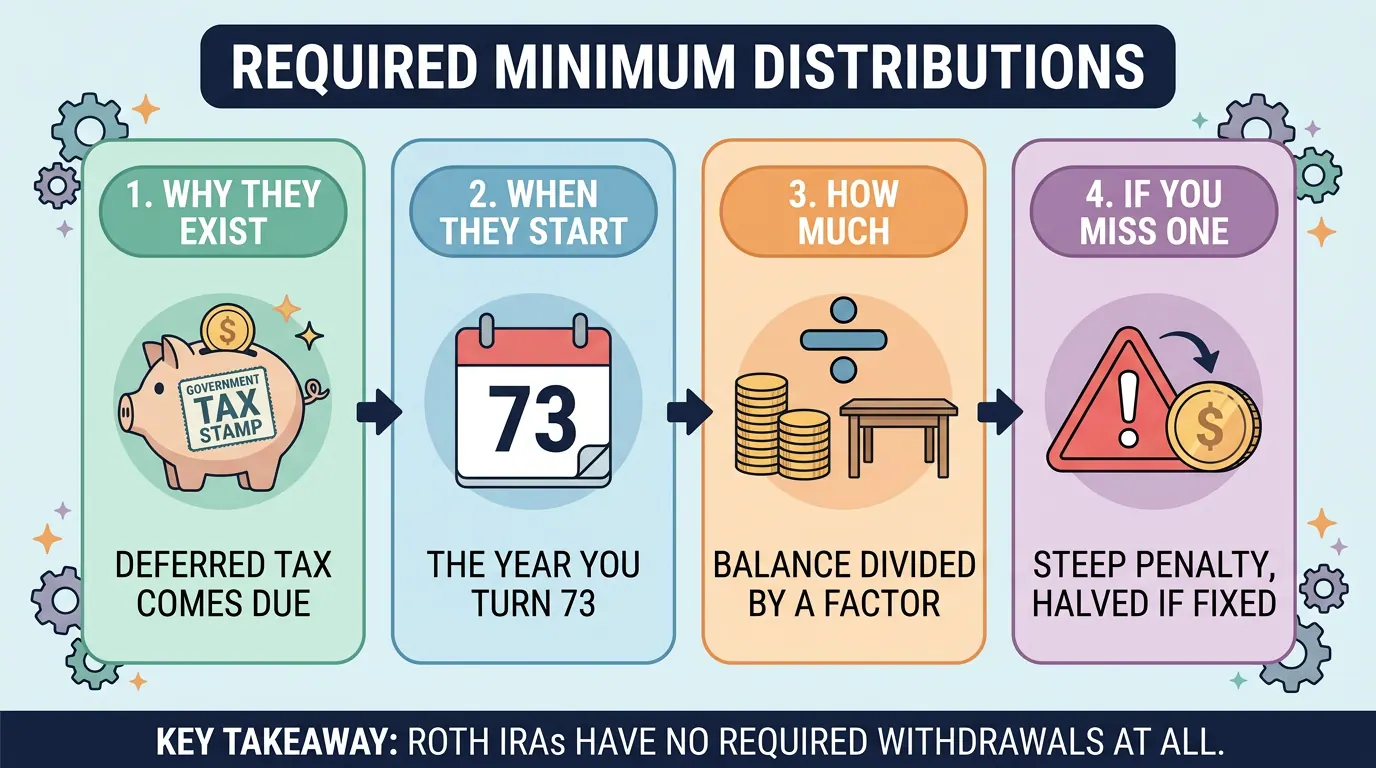
A traditional 401(k) or IRA is funded with pre-tax dollars, meaning you took a tax deduction when you contributed and the money has grown untaxed ever since. The government has been waiting the entire time to collect.
Left to their own devices, wealthy retirees would leave those accounts untouched indefinitely and pass them to heirs, deferring the tax forever. RMDs prevent that. They force the account to be drained gradually so the deferred tax finally gets paid.
This is also why Roth accounts are exempt. You already paid the tax on the way in, so the government has no claim waiting.
When They Start
The starting age has moved twice in recent years, so older articles are unreliable here.
Under current law, the RMD age is 73 for anyone born between 1951 and 1959. For anyone born in 1960 or later, it rises to 75 beginning in 2033.
Anyone currently in their twenties or thirties should plan around 75.
You get a small amount of flexibility on the first one. Your first RMD can be delayed until April 1 of the year after you turn the applicable age. That sounds like a free extension and is usually a trap, because taking the first and second distributions in the same calendar year stacks both into one year's taxable income, potentially pushing you into a higher bracket and triggering income-based Medicare premium surcharges. Most people are better off taking the first one on time.
There is also a still-working exception. If you are still employed at the age you would otherwise begin, and you do not own more than 5% of the company, you can generally delay RMDs from that employer's plan until the year you actually retire. It covers only that current employer's 401(k), not plans left behind at earlier jobs, and it never applies to traditional IRAs.
How the Amount Is Calculated
The calculation is simpler than its reputation. You take your account balance as of December 31 of the previous year and divide it by a life expectancy factor published by the IRS.
For someone who is 73, that factor is 26.5. So:
Account balance on December 31: $750,000
Divide by 26.5
Required distribution: about $28,302
The factor shrinks as you age, which means the required percentage rises over time. At 73 you are withdrawing roughly 3.8% of the balance. By your mid-eighties it is well above 6%.
The money does not have to be spent. It has to leave the tax-deferred account. You can withdraw it, pay the tax, and reinvest the remainder in a regular taxable brokerage account if you do not need the cash.
The Penalty for Missing One
This used to be one of the harshest penalties in the tax code, at 50% of the shortfall. It has been reduced.
The current penalty is 25% of the amount you failed to withdraw. If you correct the mistake within a two-year window and file the appropriate form, it drops to 10%.
On the $28,302 distribution above, missing it entirely costs about $7,076, or about $2,830 if corrected promptly. Still expensive, and entirely avoidable, since most custodians will calculate the amount for you and can automate the withdrawal.
Which Accounts Are Affected
This is the part with practical consequences for a decision you may be making today.
Subject to RMDs:
Traditional IRAs
Traditional 401(k), 403(b), and 457 plans
SEP and SIMPLE IRAs
Not subject to RMDs during your lifetime:
Roth IRAs
Roth 401(k) accounts, which became exempt starting in 2024
A note on the mechanics for people with several accounts. If you have multiple IRAs, you calculate the requirement for each but may take the total from any one of them. Employer plans do not work that way: each 401(k) requires its own separate distribution, which is one more argument for consolidating old workplace accounts into an IRA when you change jobs.
Inherited accounts follow a separate and much tighter rule. Most non-spouse beneficiaries who inherit an IRA now have to empty the entire account within ten years of the original owner's death, rather than stretching withdrawals across their own lifetime. If the original owner had already started taking RMDs, the beneficiary also has to take an annual withdrawal in each of those ten years, not just a lump sum at the end. If the owner died before their RMDs began, only the ten-year deadline applies. Surviving spouses and a few other categories, such as minor children of the owner and disabled beneficiaries, get more favorable treatment.
The Reason This Matters at 25
Here is the connection back to a choice you can make now.
Traditional accounts give you a tax deduction today and force taxable withdrawals starting at 73 or 75. Roth accounts give you no deduction today and never force anything.
For someone early in a career, likely in one of the lowest tax brackets they will ever occupy, the Roth version is often the better bet anyway. The absence of RMDs is a second, independent reason to favor it. A Roth account can sit untouched through your entire retirement, growing tax free, available if you need it and undisturbed if you do not.
There is also an intermediate strategy for later in life. In the gap between retiring and reaching RMD age, some people convert portions of a traditional IRA into a Roth IRA, paying tax voluntarily during low-income years to shrink the balance that will eventually be subject to forced withdrawals. That is a decision for your sixties, not your twenties, but it is worth knowing the option exists.
One Useful Exception
If you are charitably inclined once you reach RMD age, a qualified charitable distribution lets you send money directly from an IRA to a qualified charity. The amount counts toward your required distribution and is excluded from your taxable income entirely, which is better treatment than withdrawing the money and then claiming a charitable deduction. The 2026 limit is $111,000.
Summary
Required minimum distributions force money out of pre-tax retirement accounts so the deferred tax finally gets collected, starting at age 73 for people born 1951 through 1959 and rising to 75 in 2033 for anyone born in 1960 or later. The amount is your prior-year-end balance divided by an IRS life expectancy factor, which produces roughly a 3.8% withdrawal at 73 and a rising percentage thereafter. Missing one costs 25% of the shortfall, reduced to 10% if corrected within two years. Roth IRAs and Roth 401(k) accounts are exempt during your lifetime, which is a meaningful second argument for choosing Roth contributions early in a career when your tax rate is likely at its lowest.