Life insurance is the only insurance product that is routinely sold as an investment, and that framing is the source of nearly every bad life insurance decision made in America.
Start with what the product does. Life insurance pays a lump sum to people you name when you die. That is the entire function. Whether it should also be a savings vehicle is the argument, and it is worth understanding both sides before someone with a commission explains it to you.
First: Do You Need Any?
The purpose of life insurance is to replace income that other people depend on. That gives you a clean test.
If nobody would suffer financially when you die, you probably do not need coverage. A single 24-year-old with no children, no dependents, and no co-signed debt is insuring against a loss that does not exist. Money spent on premiums would do more in a retirement account.
If someone would suffer financially, you need coverage. A spouse who could not carry the mortgage alone, children whose care costs money, a parent who depends on your support, or a business partner tied to your income all create a real need.
Two things people misjudge. A stay-at-home parent needs coverage, because replacing full-time childcare and household work costs real money. And federal student loans are discharged at death, while private loans with a co-signer generally are not, which is a common and unpleasant surprise.
The Three Products
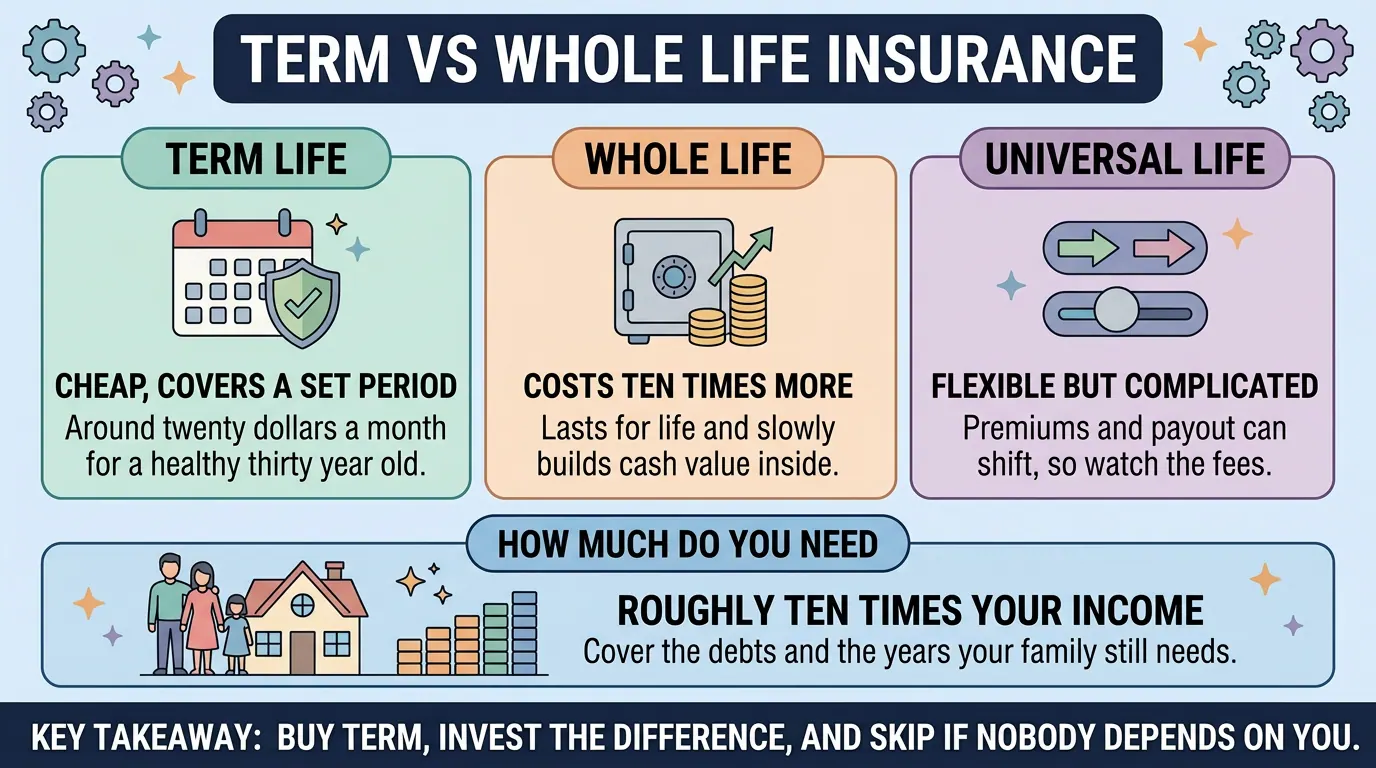
Term life covers you for a fixed period, usually 10, 20, or 30 years. If you die during the term, it pays. If you outlive it, coverage ends and you get nothing back. It has no savings component, and it is dramatically cheaper than the alternatives.
Whole life covers you for your entire life, with a fixed premium and a savings component called cash value that accumulates over time. You can borrow against the cash value or surrender the policy for it. Premiums typically run five to fifteen times a comparable term policy.
Universal life is permanent coverage with flexible premiums and cash value tied to interest rates or, in some versions, to market index performance. It is more complicated than whole life and its performance depends heavily on assumptions in the illustration you are shown.
What It Actually Costs
For a healthy 30-year-old non-smoker, $500,000 of 20-year term coverage averages roughly $25 to $30 per month for a man and somewhat less for a woman.
A comparable whole life policy at that age commonly runs several hundred dollars a month for the same death benefit.
That gap is the entire debate. You are being asked whether the difference is better spent on cash value inside an insurance policy or invested somewhere else.
Premiums rise steeply with age and with health class. The same policy purchased at 45 costs several times what it costs at 30, and locking in a rate while young and healthy is one of the few genuine advantages of buying early.
Where "Buy Term and Invest the Difference" Comes From
The standard advice has a specific arithmetic basis.
Cash value inside a whole life policy grows slowly. Early years are consumed largely by commissions and fees, so the cash value is often near zero for the first several years. Long-run internal returns tend to land in the low single digits. Meanwhile, US stocks have historically averaged roughly 10% nominally and about 7% after inflation over long periods.
So the comparison runs: buy the term policy, invest the several hundred dollars a month you did not spend on whole life, and by the time the term expires you should have accumulated enough that you no longer need insurance. Your mortgage is paid, your children are grown, your retirement accounts are funded. The need the policy existed to cover has disappeared on its own.
This is why term is the right answer for the large majority of people. The need for life insurance is usually temporary, and paying permanently for a temporary need is expensive.
The Case for Permanent Coverage
The counterarguments are real for a minority of situations, and dismissing them entirely is as sloppy as accepting the sales pitch.
A permanent need. A child with a disability who will require lifelong support does not stop needing support when you turn 65. Term coverage that expires is the wrong tool.
Estate planning at scale. For estates large enough to face estate tax, permanent insurance can provide liquidity to pay it without forcing heirs to sell illiquid assets like a family business. The federal exemption is high enough that this affects very few families, but a number of states impose their own at lower thresholds.
Forced savings that actually happens. "Invest the difference" assumes you invest the difference. Some people genuinely will not, and for them a mediocre return they cannot easily abandon may beat a good return they never start.
Uninsurability later. Permanent coverage bought while healthy remains in force regardless of a later diagnosis.
None of these describe a typical 30-year-old with a mortgage and two kids. All of them describe someone.
How Much Coverage
Two methods, and it is worth running both.
Income multiple. Ten to twelve times your annual income. Fast, crude, and adequate for most people. Someone earning $70,000 buys $700,000 to $840,000.
DIME. Add up Debt, Income replacement for the years your dependents need it, Mortgage balance, and Education costs for your children. Slower and more accurate, because it reflects your actual obligations rather than a rule of thumb.
Run the numbers before you shop. Agents quote what you ask for, and going in without a figure invites the recommendation that pays best.
The Policy Through Work Is Not Enough
Most employers provide group life insurance, often one or two times your salary, at no cost to you. Take it. It is free coverage.
Two limitations mean it cannot be your whole plan.
The amount is too small. One times a $70,000 salary is $70,000, against a need closer to $700,000.
It is not portable. Group coverage generally ends when your employment does. Conversion options exist but are frequently expensive and limited. Anyone whose entire life insurance plan is their employer's policy loses that plan on the day they change jobs, which is often a day they are already dealing with a drop in income.
Summary
Life insurance replaces income that other people depend on, so if nobody would suffer financially when you die you probably do not need it yet. Term life covers a fixed period with no savings component and costs roughly $25 to $30 per month for $500,000 of 20-year coverage for a healthy 30-year-old, while comparable whole life commonly costs several hundred dollars monthly for the same death benefit. Because cash value inside a policy tends to return low single digits against a historical 7% real return in stocks, buying term and investing the difference is the right answer for most people, whose need for coverage is temporary anyway. Permanent coverage genuinely fits a minority of cases including lifelong dependents and estate tax liquidity, and employer group coverage is worth taking but is both too small and not portable.